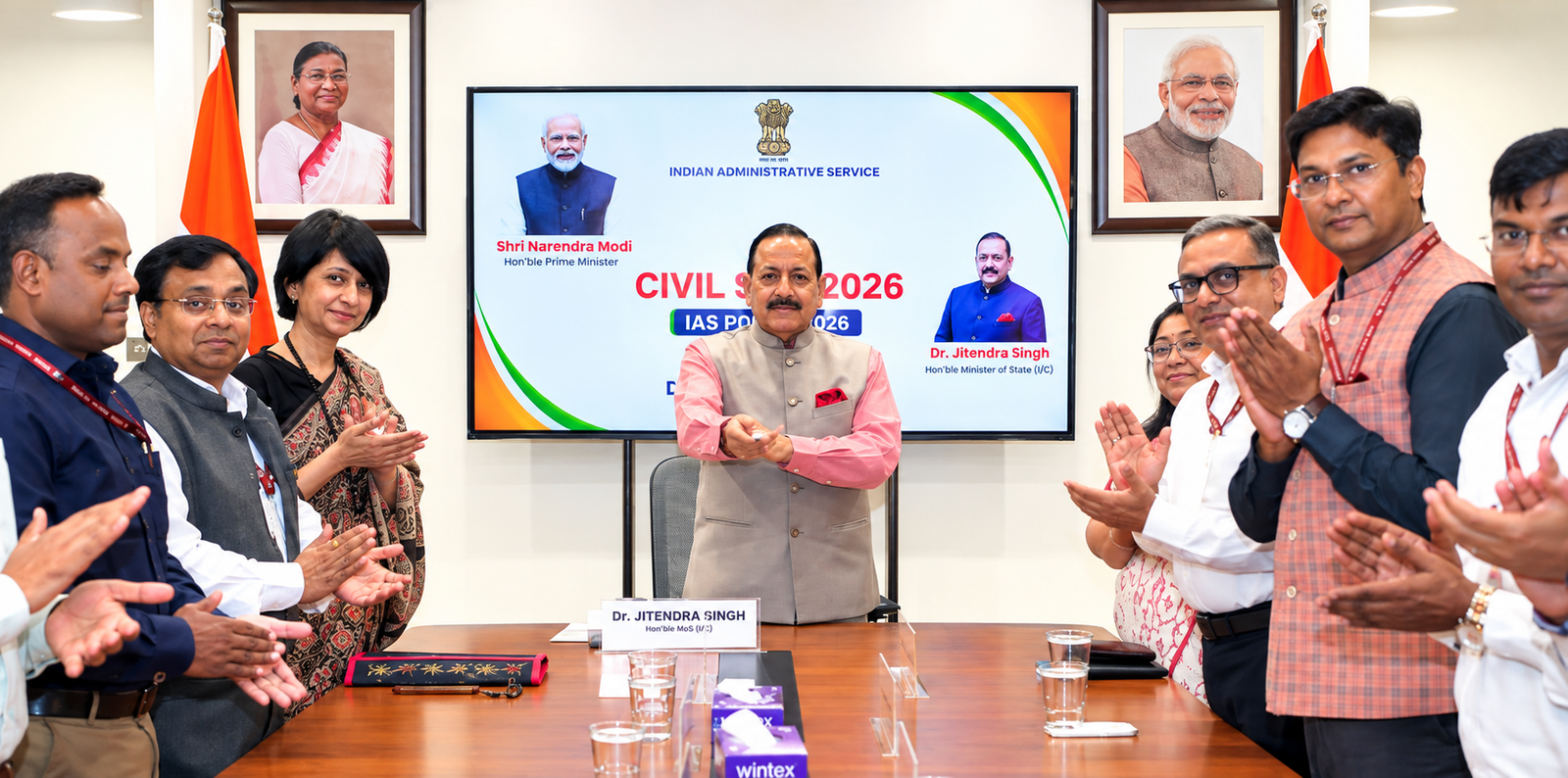
The government’s long-running effort to bring more transparency and ease into the way it manages its top civil servants took a clear step forward this year. On 22 June 2026, Union Minister Dr Jitendra Singh formally launched the IAS e-Civil List 2026 at Kartavya Bhawan in New Delhi. What used to be a thick printed directory is now a searchable digital document that anyone can open on the Department of Personnel and Training website.
This is the 71st edition of the Civil List and the sixth one released purely as an e-book. It carries the usual details that officers, journalists and researchers have always looked for — batch year, cadre, current posting, pay level, educational qualifications and the date an officer is due to retire. What makes the 2026 version more useful is the advanced search and hyperlinking. You can look up officers by domain experience or simply click through related information without flipping pages.
As on 1 January 2026 the authorised strength of the IAS stood at 7,026. Against that, only 5,755 officers were actually in position across the 25 cadres. That gap of roughly 1,271 officers — about 18 per cent — is not new, but the digital list puts the numbers in one place and also shows how many officers are expected to retire in the next five years. For states that are already short of experienced hands, those projections matter.
Dr Jitendra Singh, who also looks after the Personnel portfolio, described the list as more than a directory. In his remarks he called it a tool for talent mapping and evidence-based administrative planning. When the government needs someone with a particular background for a new scheme or a crisis posting, the searchable data should make the search quicker. The DoPT has stopped printing the bulky physical copies, which fits neatly with the larger push for paperless offices under Digital India.
The list is free to access on dopt.gov.in. State governments and central ministries already feed their data into it, so the information stays reasonably current. Of course, no database is perfect the day it is uploaded, and occasional corrections will continue, but the shift from paper to searchable PDF is a practical improvement that most people who deal with cadre matters will notice.
Around the same time the IAS list was being finalised, the Ministry of Home Affairs made a quieter but important change for the Indian Police Service. On 28 January 2026 it modified the guidelines for empanelment of IPS officers to Inspector General and equivalent posts at the Centre. From the 2011 batch onwards, officers must now have completed at least two years of central deputation at the SP or DIG level (or equivalent) before they can be considered for IG-level empanelment in Delhi.
Earlier, central experience was preferred but not mandatory. The new rule is meant to address the persistent shortage of mid-level officers in the Central Armed Police Forces and other central organisations. As of late 2025 there were still dozens of vacant DIG posts and more than a hundred SP-level vacancies across these forces. By making a central stint compulsory for future promotions, the government hopes more officers will opt for deputation earlier in their careers.
The change applies only to officers of the 2011 batch and later. Those batches are currently at DIG or equivalent ranks in their state cadres, so the impact will show up gradually over the next few years rather than overnight. Several new orders related to deputation and senior postings have also appeared on the IPS portal through 2026, signalling that the Home Ministry is actively managing the flow of officers between states and the Centre.
Taken together, the two developments point in the same direction. Whether it is the searchable IAS Civil List or the tighter empanelment norms for IPS officers, the emphasis is on better information and clearer career pathways. Governance keeps expanding — new schemes, new security challenges, new development targets — and the people who run it need systems that can keep up.
The e-Civil List will not magically fill the 1,271 vacant IAS posts, just as the revised IPS guidelines will not instantly staff every empty DIG chair. But both moves reduce the friction that used to exist when someone simply wanted to know who was available, where they had served, and what experience they brought. In a system as large and spread out as India’s civil services, that kind of practical clarity is worth having.
The list remains a living document. As more officers join through the Civil Services Examination or get promoted from state services, and as postings change, the digital version can be updated far more easily than the old printed volumes ever could. For anyone who follows cadre politics or simply needs reliable service data, the 2026 edition is the place to start.
Sources:
- Press Information Bureau release, 22 June 2026
- Department of Personnel and Training website (dopt.gov.in) and IAS Civil List portal
- Ministry of Home Affairs communication dated 28 January 2026 on IPS empanelment guidelines
- Reports from The Indian Express, Hindustan Times and News18 on the January 2026 IPS rule change
Written By – Anjali Pandey
Publisher By – Rohit Manral