
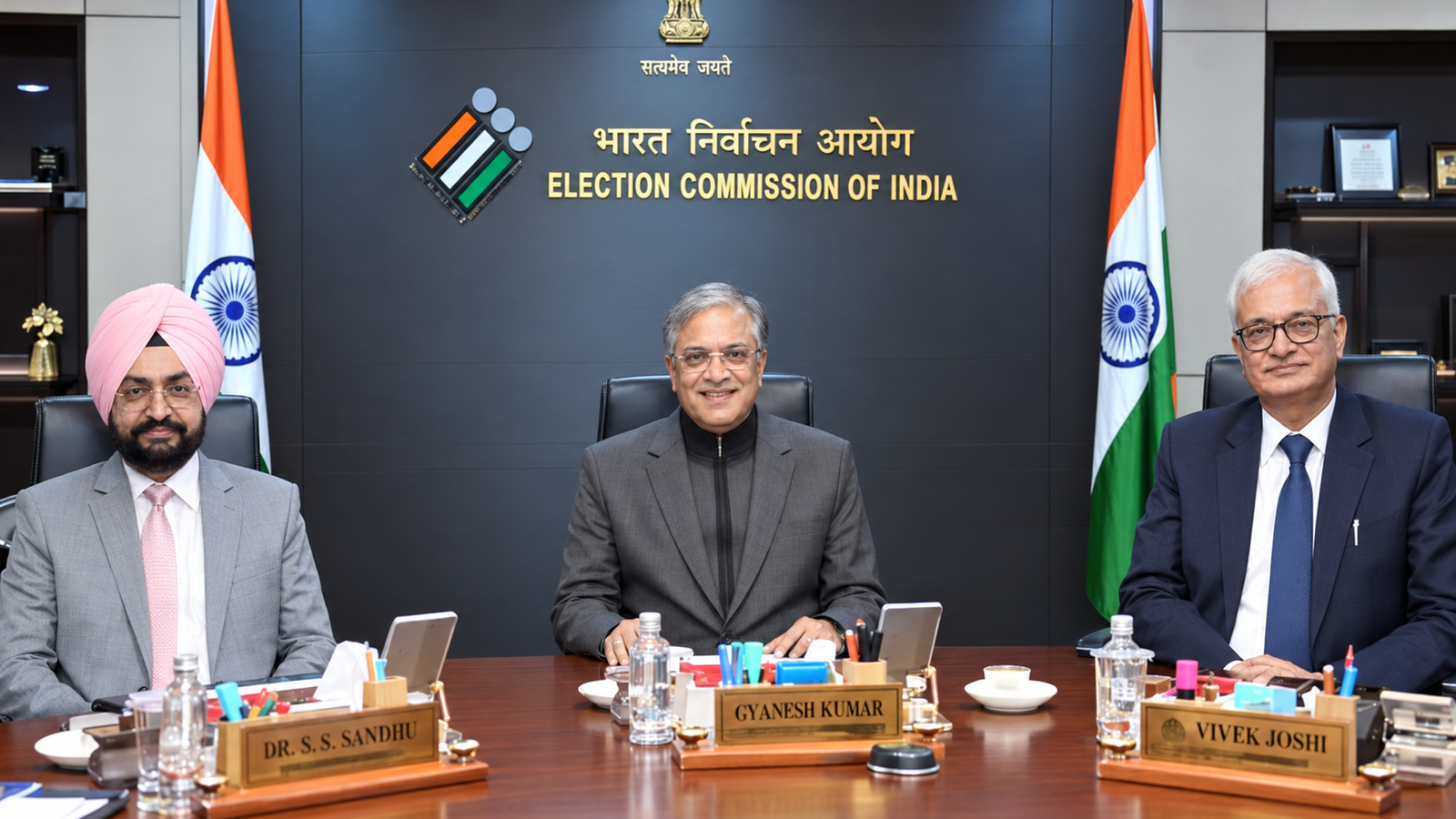
New Delhi: Papers released under the Right to Information Act have brought into the open what two Election Commissioners wrote to the country’s top bureaucrat in July. Sukhbir Singh Sandhu and Vivek Joshi each sent separate letters on 29 July to Cabinet Secretary T.V. Somanathan. They raised questions about how Senior Deputy Election Commissioner Maneesh Garg handled work allocation inside the Election Commission while filling in for another officer who was on leave.
The letters, obtained by retired Navy officer and transparency activist Commodore Lokesh K. Batra, describe a sequence that left the two commissioners uneasy. Deputy Election Commissioner Bhanu Prakash Yeturu, who looked after the Administration Division, was away from 27 July to 9 August. On 28 July Garg was given the additional charge as link officer. Within a few hours he issued a fresh order that reassigned responsibilities among Senior Deputy Election Commissioners, Deputy Election Commissioners, Directors General and officers of similar rank.
Sandhu wrote that the revised allocation was put out without any discussion with the Commission or with him. He noted that Garg had allocated work to himself and to officers senior or equal in rank. The same letter pointed out that similar steps had been taken earlier despite clear oral and written instructions that such changes needed prior discussion or approval from the Commission. Joshi’s letter, almost identical in language, added one more detail: when he asked to see the relevant file from the Administration Division, it was not given to him.
Both commissioners referred to Sections 18(1) and 18(2) of the Chief Election Commissioner and Other Election Commissioners (Appointment, Conditions of Service and Term of Office) Act, 2023. They asked for appropriate action.
The work order also touched the routing of files from the IT Division headed by Director General Seema Khanna. Earlier those files used to move through Deputy Election Commissioner Sanjay Kumar. The new arrangement removed that step. Later reports noted that Kumar was repatriated to his parent cadre in Delhi in August, before his normal tenure ended. The Election Commission has said the redistribution order itself was never put into effect after the two commissioners raised objections, and that the letters concerned an officer on deputation rather than any policy or IT matter.
Inside the Cabinet Secretariat the letters were examined. File notings from early August record that the communications came from the two Election Commissioners in their individual capacity. Officials noted that acting on them without a formal communication from the Election Commission as a whole could be seen as interference in the functioning of a constitutional body. The Secretariat is designed to keep the poll panel insulated from the executive. On 5 August the Cabinet Secretary acknowledged the letters and marked copies to Chief Election Commissioner Gyanesh Kumar and to the Department of Personnel and Training. No further action followed from the Secretariat.
The episode sits against a wider backdrop of questions about internal coordination inside the Election Commission during the Special Intensive Revision of electoral rolls. Earlier newspaper reports had spoken of repeated notes from Sandhu and Joshi objecting to decisions taken without their knowledge. The RTI disclosure now places the July correspondence on public record and shows how the Cabinet Secretariat chose to treat the matter as an internal concern of the Commission rather than a subject for external intervention.
Garg, an IAS officer of the Himachal Pradesh cadre, has been with the Commission since September 2024 after appointment by the Appointments Committee of the Cabinet. The two commissioners’ letters did not claim any policy shift on electoral rolls; they focused on the manner in which administrative orders were issued and the absence of consultation.
For its part the Election Commission has maintained that once the two commissioners objected, the disputed work-allocation orders were not implemented. The repatriation of Sanjay Kumar was described in official papers as being on personal grounds, though the timing coincided with the period of friction over file routing.
The RTI reply has not released every page of the original letters or the full internal discussion. What it does confirm is the existence of the complaints, the precise date they were sent, the officer they named, and the Secretariat’s decision to stop at acknowledgement and information to the Chief Election Commissioner. In a system that places high value on the independence of the Election Commission, the choice not to step in is consistent with the principle that the poll body must manage its own internal arrangements.
Whether the concerns raised by Sandhu and Joshi have been fully resolved inside Nirvachan Sadan remains a matter for the Commission itself. The public now has the documentary trail that shows two of its three members felt the need to write outside the building when they believed established procedures had been bypassed. The Cabinet Secretariat’s response underlines the boundary it is prepared to respect between executive offices and a constitutional institution.
Sources: The Wire (22 October 2026), The Indian Express (23 October 2026), Business Standard (23 October 2026), The Times of India (23-24 October 2026), Hindustan Times reports referenced in subsequent coverage, and RTI reply obtained by Commodore Lokesh K. Batra (Retd.).
Publisher By – Rohit Manral
Written By – Anjali Pandey