When the Files Start Moving Online and the Babus Get Called Out
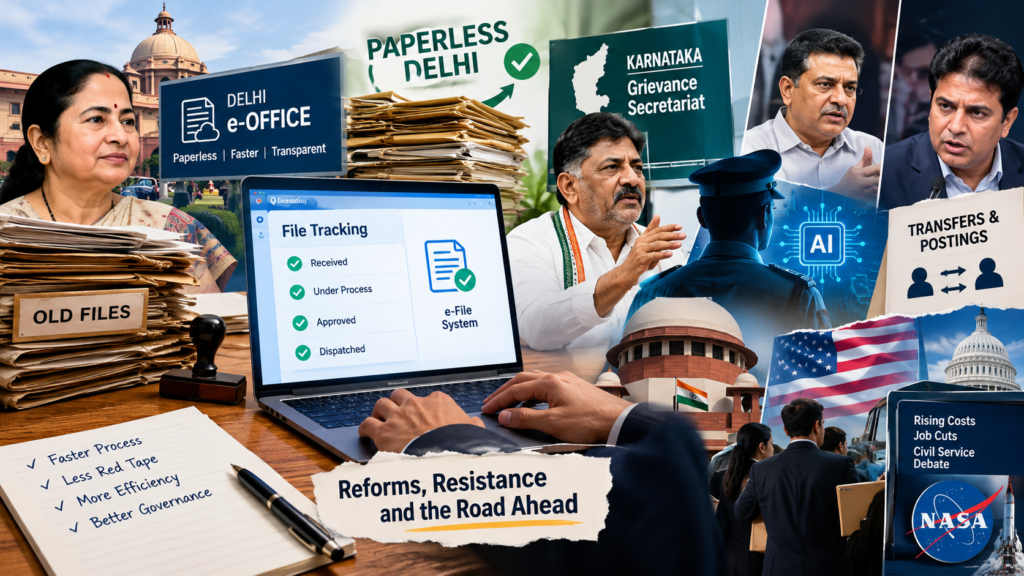
Delhi e-office system just completed one full year. Over 75 percent of the administrative files are now moving online. The CM, Rekha Gupta, said 120 departments have gone completely paperless. Imagine that. Stuff that used to sit on someone’s desk for days is now zipping through the system, and there’s a digital trail so people can’t just “misplace” things. Of course, some of the older officers still prefer the physical file and the rubber stamp, but the direction is clear. The paper mountain in Delhi is finally starting to shrink. Then look at Karnataka. Chief Minister D.K. Shivakumar has announced a separate secretariat just for public grievances. He’s told officers to make departmental action plans within 15 days and, more importantly, asked them to work transparently and not bow to political pressure. That’s a pretty direct message: do your job properly without constantly looking over your shoulder. Whether it actually changes anything on the ground, we’ll see. But at least the signal is out in the open. Not everything is smooth though. In Kerala there’s this suspended IAS officer, B. Ashok. He got suspended for allegedly criticising the government in the media during elections. Now he’s hit back hard. He’s saying the suspension is unfair, that the Left government is intolerant, and that they’re undermining the independence of bureaucrats. These public fights between officers and politicians always make noise, and this one is no different. When a senior guy comes out and says the system is being misused, people listen. And then there’s KTR. At some summit in Chennai he didn’t hold back at all. He called India’s bureaucracy “static” and said it’s still one of the biggest hurdles in politics, carrying the same old Licence Raj mindset. He even clubbed the judiciary in the same criticism. Coming from someone who’s dealt with the system for years, it lands differently. A lot of people quietly agree that the steel frame has become pretty rusty in places. On the reform side, the Department of Personnel and Training has decided to bring in a private consultant to overhaul the bureaucracy. The idea is simple: cut the red tape, push digital work harder, make things more efficient. They’re also expanding lateral entry so more specialists from outside can come in. Some people think this is necessary oxygen. Others worry it’ll create two classes of officers and dilute the service culture. The debate is very much alive. There’s also this quieter but interesting thing happening with the IPS. AI tools like ChatGPT are now being used in their training and daily work. It’s still early, but the fact that police officers are being told to get comfortable with these tools shows even the most hierarchical services are having to change with the times. Meanwhile the usual transfer circus continues. Tamil Nadu moved five IAS officers, one of them A. Karthik going to Home. Gaurav Yadav has been made regular DGP of Punjab. Himanshu Khurana has gone as Deputy Secretary in the Cabinet Secretariat. These are the everyday postings that keep the machine running even if they don’t make big headlines. If you look outside India, the picture is different but the tension is similar. In America, federal employees are watching their health insurance premiums jump for the third year in a row. Some plans have gone up by double digits. There have been fights over job cuts, flexible work schedules being pulled back, and constant arguments about how much protection civil servants should have. Trust in government is low, yet surveys show people actually think ordinary civil servants are more competent and committed than the politicians above them. NASA has done something unusual. They’re bringing thousands of contractors back as actual civil servants because they want to rebuild their core technical strength. In a time when most governments prefer contractors (easier to hire and fire), this is a rare move in the other direction. What connects all of this is the same old tug of war. Governments want a bureaucracy that is fast, responsive, and listens to them. Officers want enough space to do their work without constant political interference. And ordinary people just want their files to move and their problems to get solved. Digital tools are helping in places like Delhi. Political pressure is still heavy in others. Reform talk is loud, but real change on the ground is always slower. The next few months will tell us whether the paperless push, the grievance secretariats, the lateral entries, and the AI experiments actually make a difference that people can feel. Or whether we’ll still be sitting and complaining about the same delays next year. For now, at least the conversation around bureaucrats is livelier than usual. And that itself is something. Sources:Telangana Today (bureaucracy coverage, 10 Oct 2026)LegendOfficers.com (bureaucracy news updates, 9 Oct 2026)Government Executive (federal pay, benefits and civil service reports, early Oct 2026) Publisher By – Rohit Manral Written By – Anjali Pandey