Does being ‘faceless’ in the government system mean being ‘accountability-less’?
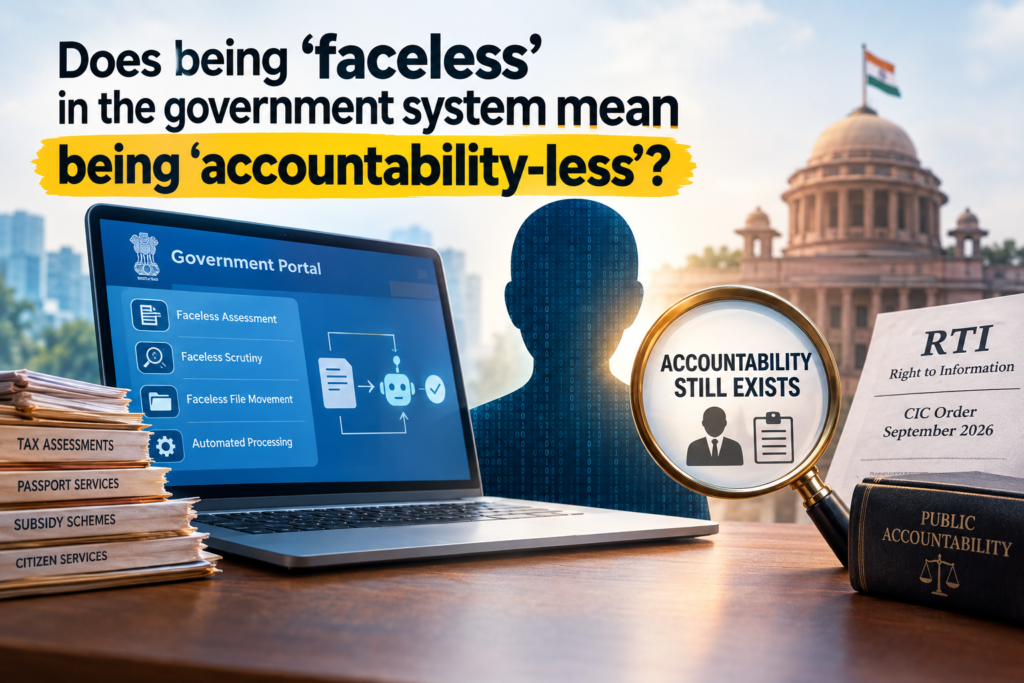
We keep hearing this word everywhere now — faceless. Faceless assessment, faceless scrutiny, faceless file movement, faceless everything. On paper it sounds clean. No face-to-face, no middlemen, less chance of someone asking for chai-paani. The machine does the work, the portal decides, the algorithm moves the file. Everyone claps. But here’s the real question that keeps coming back: when something goes wrong, who do you hold accountable? In September 2026, the Central Information Commission dealt with an RTI matter and said something that should have been obvious but somehow needed saying out loud. Automated or faceless administration cannot wipe out responsibility. Accountability does not disappear just because a human face is no longer visible on the file. That one line cuts through a lot of the current confusion. Think about how many people file RTIs these days only to get replies that basically say, “The system generated it,” or “It was processed under the faceless scheme,” or “No individual officer is involved.” It feels neat and technical. It also feels like a perfect escape route. The moment you remove the person, you also try to remove the responsibility that person carried. But systems don’t run themselves. Someone designs the rules the system follows. Someone decides which data goes in, which parameters matter, which exceptions are allowed, and when a case gets escalated. Someone sits in the control room even if the public never sees their name. Faceless does not mean ownerless. The CIC’s point was simple and sharp. You can automate the process. You cannot automate away the duty to answer for the outcome. If an order is wrong, if a file is delayed beyond reason, if a citizen is denied something they were entitled to, the public still has the right to know who decided what and on what basis. The RTI Act was never meant to stop at the edge of a software interface. We have seen this tension play out in tax assessments for years. Faceless assessments were sold as the end of harassment. In many cases they did reduce unnecessary meetings. Yet when a high-pitched demand comes or a genuine explanation is ignored, the assessee is left talking to a faceless unit. The same pattern is slowly spreading to other departments. Passport work, certain subsidy schemes, some service delivery portals — the human is being removed from the frame, and with it the easy trail of responsibility. That is dangerous. Accountability is not a luxury. It is the only thing that keeps power from becoming casual. When an officer knows that one day someone can ask, “Why did you take this decision?” the quality of decisions improves. When the same officer can hide behind “the system did it,” the quality starts slipping. Mistakes stop getting fixed. Patterns of error stop getting noticed. Citizens stop believing the process is fair. Some people argue that technology is neutral. It isn’t. Technology reflects the priorities of the people who build and manage it. If those people are not answerable, the technology becomes a shield instead of a tool. The CIC order simply refused to accept that shield as permanent. There is another layer to this. Faceless systems generate huge amounts of data and logs. In theory, those logs should make accountability stronger, not weaker. You should be able to pull up exactly when a decision was taken, which rule was applied, which officer last touched the case, and what the system recorded as the reason. But that only happens if the department is willing to treat those logs as public records under the RTI Act and not as internal technical details that citizens have no business seeing. Many still treat them as the latter. The September decision pushes in the opposite direction. It reminds public authorities that the shift to automated administration does not rewrite the basic compact between citizen and state. You can change the method of work. You cannot change the fact that the work is still being done in the name of the people and with public money. Therefore the people still get to ask questions. This is not an argument against technology. Nobody serious is saying we should go back to paper files and long queues for everything. Speed and reduced physical interface have real value. The argument is narrower and more important: do not use “faceless” as a synonym for “no one is responsible.” In the end it comes down to a simple test. If a citizen is harmed by an automated decision, is there a clear path to find out who owns that decision and how it can be corrected? If the answer is no, then the system has failed the purpose of public administration. If the answer is yes, then faceless can work. The CIC has now put it on record that the second answer is the only acceptable one. Automated processes are allowed. Accountability-less processes are not. That is not a technical observation. That is a democratic one. And it needed saying. Publisher By – Rohit Manral Written By – Anjali Pandey
What to Do When a Government Officer Just Won’t Listen
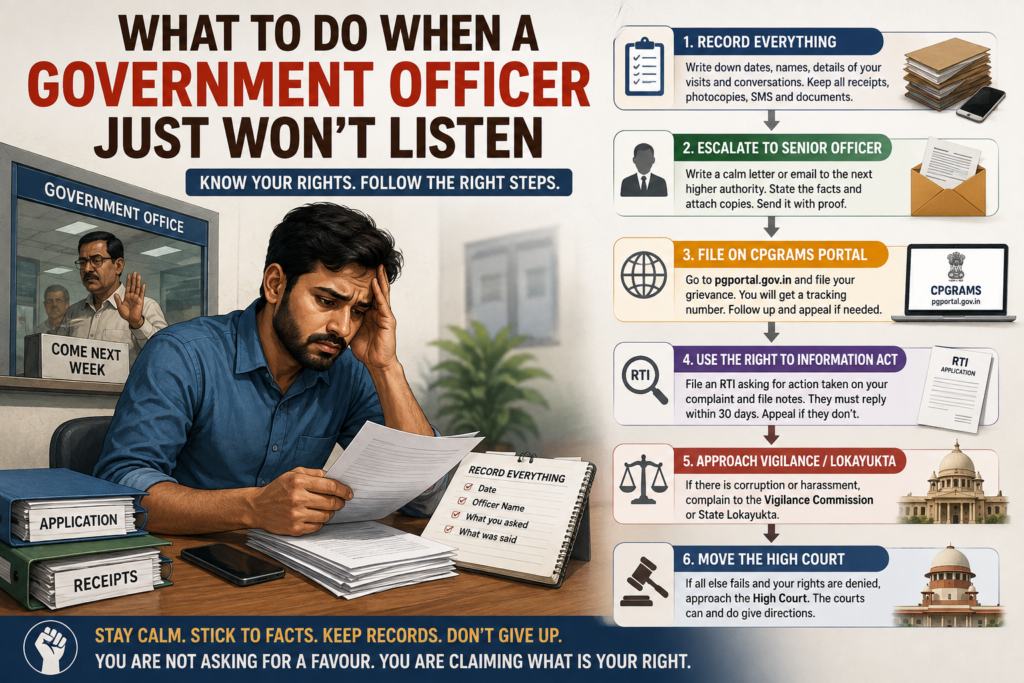
You went to the office, submitted whatever papers were needed, waited politely, followed up a couple of times… and nothing. The officer either looks through you or says “come next week” until the weeks turn into months. It’s exhausting and it makes you feel small. Here’s the quiet truth most people figure out only after a lot of running around: you don’t have to keep going back to the same person who is ignoring you. Start by writing everything down. Date, name of the officer, what you asked for, what was said (or not said). Keep every receipt, every photocopy, every SMS. It feels boring, but that small pile of paper later becomes your strongest friend. Next, quietly go one step above that officer. A short, calm letter or email to their boss — the next higher person in the same office — usually does more than ten more visits to the original desk. Just state the facts: “I submitted this on this date, nothing has happened, kindly look into it.” Send it in a way that leaves a record. Many files that were “stuck” suddenly start moving once a senior name is attached. If even that stays silent, use the government’s own online grievance system. It’s called CPGRAMS. You can file from your phone at pgportal.gov.in. You get a number, you can track it, and they are supposed to respond in a few weeks. If they close it without solving anything, you can appeal right there on the same site.When the portal also fails, the Right to Information Act is the tool that often breaks the silence. You simply ask, in writing, what action has been taken on your complaint and request the file notes. The law gives them thirty days. If they still don’t reply, you can appeal for free. Officers know that continued silence can cost them personally, so the same file that was “missing” often reappears. If you feel there is corruption or deliberate harassment involved, there are separate bodies — the vigilance commission or the state Lokayukta — that look into those matters. And if every door stays shut and your basic rights are being denied, the High Court is still there. People do go and the courts do give directions. The whole process is slow and sometimes frustrating, but it works for a lot of ordinary people who simply refuse to give up after the first cold shoulder. Keep your tone calm in every letter. Stick to dates and facts. Don’t get emotional on paper. And don’t stop after one attempt. You are not asking for a favour. You are asking for something you are entitled to. The system has these steps built in for exactly this situation. Use them, one after another, and keep the records. That’s usually enough. @Rohit Manral