Public Opinion on Narendra Modi-Led Government Reflects Deep Divide Between Development Praise and Policy Criticism

Public opinion regarding the current Government of India, operating under the leadership of Prime Minister Narendra Modi, is far from uniform. Across different sections of society, one observes a wide spectrum of perspectives and experiences concerning the administration. Some view it as a government that makes swift decisions and takes concrete steps toward development, while others raise serious questions regarding its policies and their actual impact. Schemes run by Modi Government Supporters believe that, over the past few years, several major schemes and programs have significantly impacted the lives of common citizens. They regard the expansion of technology through “Digital India,” the increased access to banking facilities via the “Jan Dhan Yojana,” improved access to healthcare services through “Ayushman Bharat,” and the construction of homes under various housing schemes as positive transformative changes. Furthermore, the rapid development of roads, highways, and other infrastructure across the country is also cited as a major achievement of the government. Campaigns such as “Make in India” are hailed as significant strides toward enhancing India’s economic potential and bolstering its global standing. Additionally, many view India’s growing engagement on international platforms—along with its robust diplomatic presence—as a testament to the government’s success. Conversely, critics argue that issues such as unemployment, rising inflation, and the specific challenges faced by the youth and the farming community remain matters of grave concern within the country. They contend that, amidst claims of development, the tangible impact on the economic well-being of the common citizen does not appear to be as substantial as one might expect. Some also feel that questions continue to be raised regarding civil liberties, media freedom, and the functioning of democratic institutions—issues that are fundamental to the health and vitality of a democracy. This divergence of opinion becomes even more pronounced on social media platforms. On one side, messages of support, pride, and positivity regarding the government’s schemes and leadership are constantly shared; on the other, criticism, debate, and dissent concerning its policies, decisions, and their consequences are voiced openly. These diverse reactions collectively reflect the complexity of the contemporary political landscape and the very nature of democratic discourse.
India’s Democracy: Voter Power vs. the Shadows of Caste, Lies, and Self-Serving Leaders
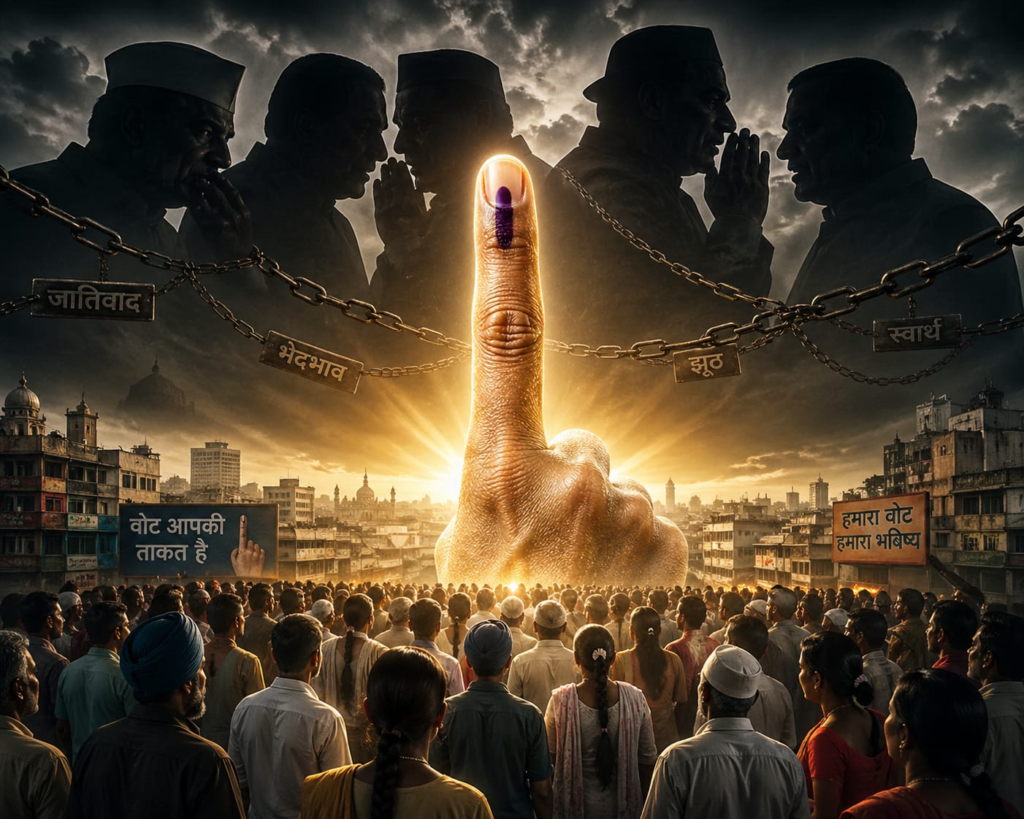
Politics entails much more than simply electing leaders or holding elections; in reality, it determines the quality of education our children receive, the standard of our hospitals, and how essential amenities—such as roads, electricity, and water—are provided. Furthermore, it is politics that determines how justice and equality are upheld within society. In simple terms, politics is inextricably linked to the everyday lives of ordinary people. Politics has two distinct facets: one is humanity, and the other is corruption. A politician, after all, is a human being; they possess their own thoughts, emotions, and limitations. Some leaders genuinely enter politics with the intention of serving and helping the public, while others step into the political arena solely for their own personal gain. If a leader introduces an affordable ration scheme for the poor, it reflects the humane aspect of politics; conversely, if a leader seeks to divide people along the lines of caste or religion, it indicates that they have entered politics solely for their own self-interest. India is a democratic nation, meaning that the public exercises its franchise to elect its most powerful leaders. In India, citizens cast their votes every five years to choose their representatives. While the act of voting to elect leaders ensures that every individual’s voice matters, the process also presents significant challenges—such as corruption, caste- and religion-based politics, and unfulfilled promises.