From “Educate, Agitate, Organize” to Mahaparinirvan Diwas: The Inspiring Legacy of B. R. Ambedkar
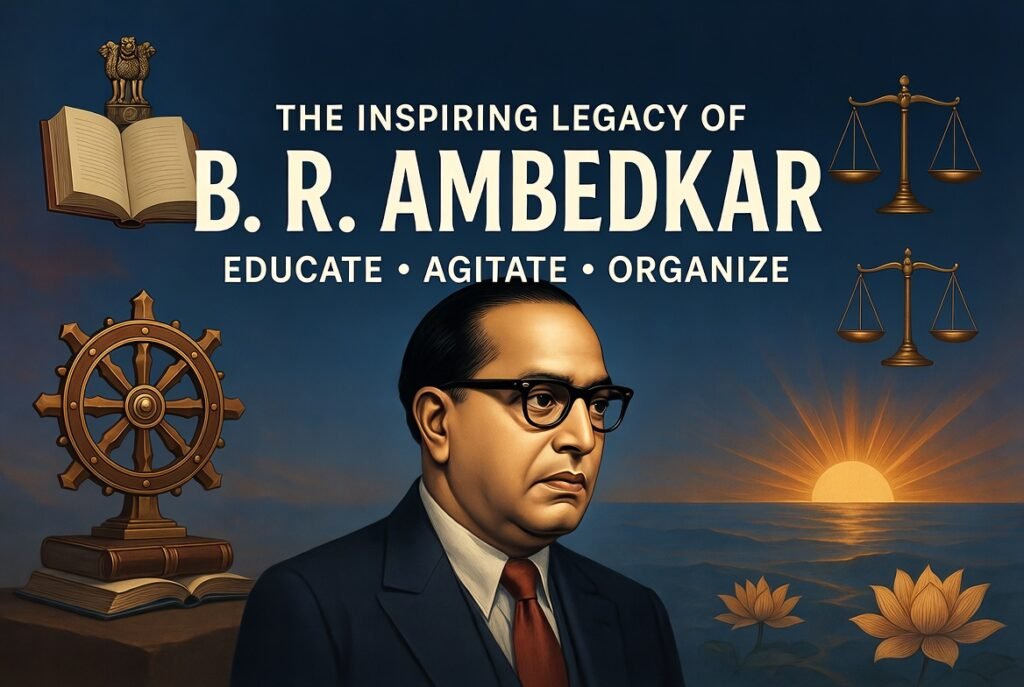
Dr. B.R. Ambedkar was the chief architect of the Indian Constitution, a prominent social reformer, economist, and India’s first Law Minister. He was born on April 14, 1892. He is known as Baba Saheb and played a key role in the struggle for the rights of Dalit women and workers and in the eradication of social evils like untouchability. Bhimrao Ambedkar received his early education in Mumbai, after which he went to London for further education, where he received an MA and PhD from Columbia University or the London School of Economics. He was the first Indian to earn a doctorate in economics abroad. Dr. Bhimrao Ambedkar is also known as the father of the Indian Constitution. Dr. Ambedkar, while serving as chairman of the Constituent Assembly, drafted the Constitution in 2 years, 11 months, and 17 days. He founded the “Bahishkrit Hitakarini Sabha” for Dalits and secured water rights through the “Mahad Satyagraha” in 1927. He also coined the slogan “Educate, Agitate, Organize.” Dr. Ambedkar also launched the newspaper “Bahishkrit Bharat” on April 3, 1927, to address the issues of Dalits. Following this, on August 15, 1936, he formed the “Independent Labour Party,” composed mostly of working-class members, to protect the interests of Dalits. After independence in 1947, he was appointed Minister of Law and Justice in the first cabinet of India’s first Prime Minister, Jawaharlal Nehru. In 1955, he published his book, “The Idea of Linguistic States.” In 1954, he was conferred the title of Bodhisattva by Buddhist monks at the “World Buddhist Council” in Kathmandu, Nepal. On October 14, 1956, he embraced Buddhism in a historic ceremony in Nagpur and died on December 6, 1956. Dr. Bhimrao Ambedkar’s death anniversary is celebrated nationwide as “Mahaparinirvan Diwas.” 3 Key Ideas Bhimrao Ambedkar Honors and Awards