
One Complaint, How Many Departments?
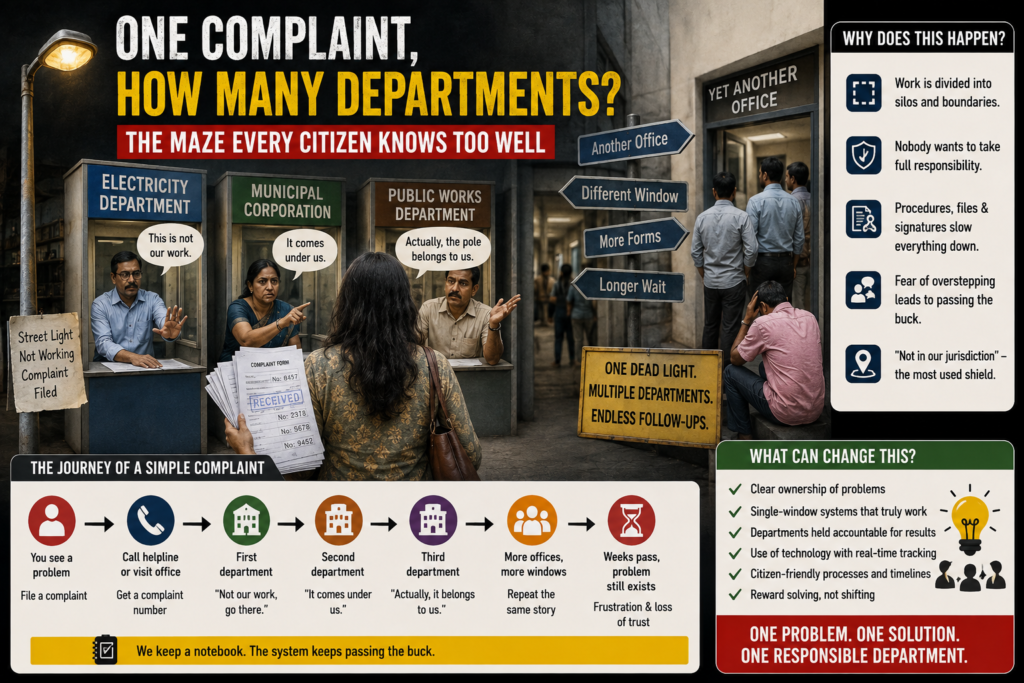
You ever file a simple complaint and feel like you’ve just entered a maze designed by someone who hates people? I have. Last year my street light went out. Not a big deal, right? One light, one pole, darkness on the corner where kids walk back from tuition. I called the local helpline, filled the form online, even went to the ward office. Three weeks later I was still being told, “Ma’am, this is under electricity department,” then “No, maintenance is with municipal corporation,” then “Actually the pole belongs to the public works side.” By the time someone finally fixed it, I had spoken to five different people across three offices and collected four different complaint numbers. One dead light. Multiple departments. That’s the story of most of us. It starts so innocently. You see a pothole, a leaking pipe, garbage not collected for days, a broken handpump, or a certificate stuck somewhere. You think, okay, I’ll just inform the concerned people. Then the ping-pong begins. The first person listens carefully, nods, and says this is not their area. They give you another number or another window. You go there. Same smile, same notebook, same “this comes under someone else.” Sometimes they even stamp your form and send it forward, which feels like progress until you realise the file is now sitting in a tray collecting dust while everyone waits for the other department to claim it. Why does this keep happening with the simplest things? Part of it is how the system is cut up. Every department has its own boundary drawn long ago, often for reasons that made sense on paper but not on the ground. Electricity handles the wire, municipal body handles the road around the pole, another office may own the land the pole stands on. When something goes wrong at the meeting point of these boundaries, nobody wants to own the full problem. Admitting responsibility means work, budget, and possible blame if it goes wrong again. So the safest move is to push it sideways. There’s also the quiet fear of overstepping. An officer who tries to solve something that is only half his responsibility can get a memo later asking why he interfered. Better to stay inside the lines. Files move slowly because every movement needs signatures, noting, and sometimes a meeting that never gets scheduled. The citizen becomes the courier between offices, carrying the same story again and again, slightly more tired each time. Then there is the classic “not in our jurisdiction” shield. It is used so often it has lost all meaning. A clogged drain near a government building can bounce between health, sanitation, and the department that owns the building. A school compound wall falling down can involve education, public works, and the local body. Nobody is lying exactly. The rules really do divide the work into thin slices. The trouble is that life does not arrive in matching thin slices. A complaint is usually one messy, living problem that crosses the lines the files refuse to cross. What makes it worse is that the person at the counter is rarely the one who can decide. He can only receive and forward. The actual decision-makers are buried deeper, protected by layers of procedure. So you keep getting polite but useless answers. “We have marked it to the concerned authority.” “Action is being taken.” “Please wait for the report.” Weeks pass. The pothole grows. The light stays dark. The garbage pile becomes a small hill. You start wondering whether the system is broken on purpose or just accidentally designed this way. I have watched this happen to neighbours, friends, even people who know someone inside. Knowing someone sometimes helps, which is its own quiet admission that the normal route is unreliable. Ordinary citizens without connections simply learn to live with the problem or keep following up until they get tired. Many stop complaining after a few tries. That silence is convenient for the system. Fewer complaints mean the numbers look better even if the streets look worse. There is a human cost that never shows up in any report. Time spent in offices during working hours, repeated explanations, the slow erosion of trust. You begin to feel that the government is not one body but a collection of separate rooms that refuse to talk to each other. The citizen is expected to do the coordination that the departments themselves avoid. It is exhausting and a little insulting. Some places have tried single-window systems and online portals that claim to track everything. They help on paper. In practice the same bouncing continues behind the screen. The portal just gives you a nicer looking status update while the file still travels from desk to desk. Until the people sitting in those desks are rewarded for solving the problem rather than for protecting their jurisdiction, the dance will continue. I still file complaints when something bothers me enough. I just go in with lower expectations and a notebook. I write down every name, every number, every date. Sometimes that notebook becomes the only continuous record the system itself does not keep. It is a small act of stubbornness. One complaint should not need five departments. Until the day that changes, we will keep walking from one window to the next, telling the same story, hoping that this time someone will finally say, “Yes, this is ours. We will fix it.” @Rohit Manral
What to Do When a Government Officer Just Won’t Listen

You went to the office, submitted whatever papers were needed, waited politely, followed up a couple of times… and nothing. The officer either looks through you or says “come next week” until the weeks turn into months. It’s exhausting and it makes you feel small. Here’s the quiet truth most people figure out only after a lot of running around: you don’t have to keep going back to the same person who is ignoring you. Start by writing everything down. Date, name of the officer, what you asked for, what was said (or not said). Keep every receipt, every photocopy, every SMS. It feels boring, but that small pile of paper later becomes your strongest friend. Next, quietly go one step above that officer. A short, calm letter or email to their boss — the next higher person in the same office — usually does more than ten more visits to the original desk. Just state the facts: “I submitted this on this date, nothing has happened, kindly look into it.” Send it in a way that leaves a record. Many files that were “stuck” suddenly start moving once a senior name is attached. If even that stays silent, use the government’s own online grievance system. It’s called CPGRAMS. You can file from your phone at pgportal.gov.in. You get a number, you can track it, and they are supposed to respond in a few weeks. If they close it without solving anything, you can appeal right there on the same site.When the portal also fails, the Right to Information Act is the tool that often breaks the silence. You simply ask, in writing, what action has been taken on your complaint and request the file notes. The law gives them thirty days. If they still don’t reply, you can appeal for free. Officers know that continued silence can cost them personally, so the same file that was “missing” often reappears. If you feel there is corruption or deliberate harassment involved, there are separate bodies — the vigilance commission or the state Lokayukta — that look into those matters. And if every door stays shut and your basic rights are being denied, the High Court is still there. People do go and the courts do give directions. The whole process is slow and sometimes frustrating, but it works for a lot of ordinary people who simply refuse to give up after the first cold shoulder. Keep your tone calm in every letter. Stick to dates and facts. Don’t get emotional on paper. And don’t stop after one attempt. You are not asking for a favour. You are asking for something you are entitled to. The system has these steps built in for exactly this situation. Use them, one after another, and keep the records. That’s usually enough. @Rohit Manral