Historic Shift in Bengal, BJP Storms to Power with Landslide Victory

The results of the 2026 West Bengal Assembly elections have brought a significant shift in the state’s political landscape. The Bharatiya Janata Party (BJP) delivered a strong performance, winning 207 out of 294 seats and is now set to form the government in the state for the first time. On the other hand, the All India Trinamool Congress (TMC) managed to secure only 80 seats. Mamta Banjerjee defeated in Bhabanipur One of the biggest highlights of this election was the defeat of Mamata Banerjee. She lost from her stronghold, Bhabanipur, to her former aide-turned-BJP leader Suvendu Adhikari. This result is being seen as a major turning point in West Bengal politics. After the results, Mamata Banerjee raised concerns over the election process and alleged irregularities in seat outcomes. Meanwhile, Prime Minister Narendra Modi described the verdict as the people’s decision and said that West Bengal will now move forward on the path of development. Election with Controversy The election also saw controversy around the voter list. Under the Special Intensive Revision (SIR), a large number of names were removed, which added to the heated political environment. After this decisive victory, preparations are underway for the BJP’s swearing-in ceremony on May 9. This marks the beginning of a new chapter in West Bengal’s political history. It will be interesting to see how the new government shapes the state’s development and political balance in the coming years.
Bengal Election Star politics Campaign
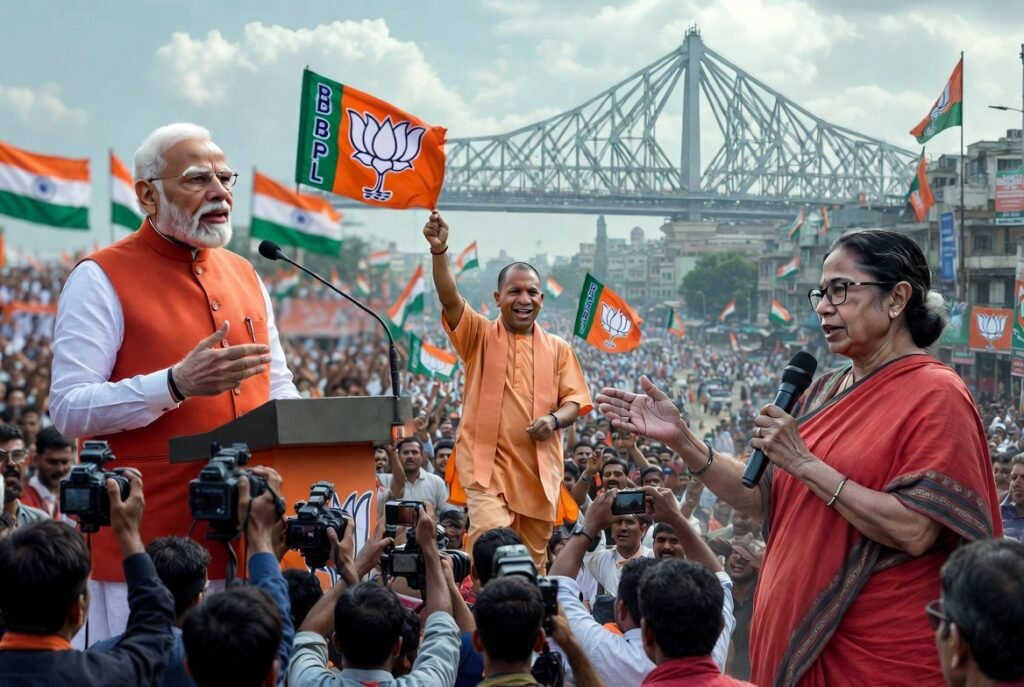
Campaigning for the second and final phase of the ongoing Assembly elections in West Bengal concludes today. In this phase, voting will take place across 142 constituencies on April 29. It is worth noting that voting for the first phase of the Bengal Assembly elections was held on April 23, witnessing a record voter turnout of 93.19%. The constituencies going to the polls in the second phase span eight electoral districts, including Kolkata North, Kolkata South, Howrah, Nadia, North 24 Parganas, South 24 Parganas, Hooghly, and Purba Bardhaman. Rallies by Star Campaigners in Bengal With the Assembly elections underway in Bengal, leaders from all major political parties are holding rallies across the state, and prominent BJP leaders have also joined the fray. Ahead of the first phase of the Assembly elections, star campaigners—such as Uttar Pradesh Chief Minister Yogi Adityanath and Defence Minister Rajnath Singh—had already addressed the people of Bengal. Today, senior BJP leader and Prime Minister Narendra Modi will address a public meeting at the Jalebi Maidan in Jagatdal, while Union Home Minister Amit Shah is scheduled to conduct two roadshows. Union Minister Amit Shah will first lead a roadshow from Behala Police Station to Manton, followed by a second roadshow organized at Chandannagar Bagbazar in Hooghly. Mamata Didi to Also Address the Public Trinamool Congress leader Mamata Banerjee also has several engagements scheduled for today; during these events, she will lead a public outreach march starting from Sukanta Setu in Jadavpur to garner support for party candidates in the Jadavpur and Tollygunge constituencies. Following the public outreach march, Mamata Banerjee will conduct a public interaction program in her own constituency, Bhabanipur. Meanwhile, Trinamool Congress All India General Secretary Abhishek Banerjee will campaign in support of party candidates in Ranaghat, Hooghly, Arambagh, and Maheshtala. Following the conclusion of the Assembly elections, the counting of votes for four states—Kerala, Assam, West Bengal, and Tamil Nadu—as well as the Union Territory of Puducherry, will take place on May 4.