The File Is Yours, So Why the Months of Waiting?
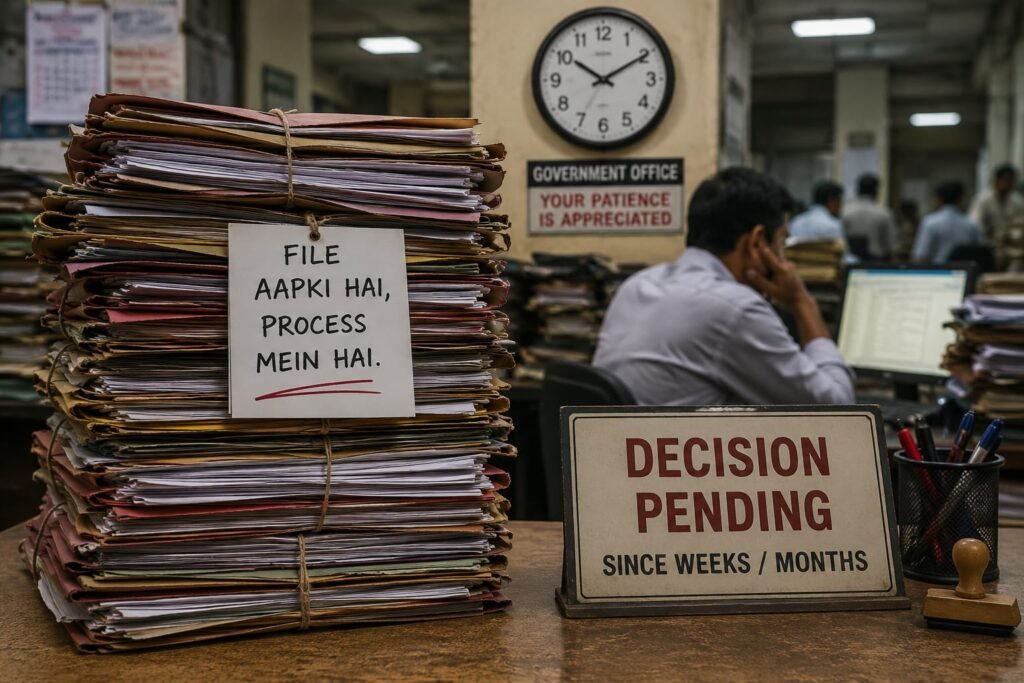
So many times it almost feels like a national anthem now. Someone walks into an office, the clerk or the officer looks at the thick file, nods, and says, “Haan, file aapki hai.” The file is yours. Everything is complete. All papers are inside. Signatures are there. Still the decision sits for weeks, sometimes months. You keep going back, drinking the same watery tea in the same dusty corridor, and the answer never changes. “Process mein hai.” Let’s talk straight, the way people actually talk when the peon isn’t listening. You submit a simple mutation of land. The papers are perfect. The survey is done. The file reaches the tehsildar’s table. He opens it, looks at it for thirty seconds, and closes it again. Why? Because the previous officer who handled similar files got transferred last month, and the new one is still “studying the system.” Or the clerk who knows which register to open is on leave for his sister’s wedding in another district. Or the stamp paper is of the old denomination and someone has to write a note about it. One small note becomes three notes, three notes become a file movement, and suddenly your land mutation is celebrating its third month inside a steel almirah. Same story with a simple building plan approval. The architect’s drawings are correct. The fire NOC is there. The structural certificate is there. Yet the file moves from junior engineer to assistant engineer to executive engineer to the municipal commissioner like a slow train that stops at every station even when no one is getting down. At every station someone finds a new “observation.” Height of the boundary wall is two inches more than allowed. Parking space calculation needs one more decimal. The signature on page 17 looks slightly different from page 3. You correct it. The file comes back with a new observation. By the time the final stamp arrives, the construction cost has gone up and the monsoon has already tested the temporary tin shed. I know a man who applied for a small government subsidy for a solar pump. The scheme was announced with big posters and bigger speeches. He filled every form, attached every bill, got the local agriculture officer’s recommendation. The file reached the district office. Then it went to the state office. Then it came back because one photocopy was not attested. He attested it. It went up again. Then someone discovered the bank account number was written in words instead of digits in one place. Corrected. Sent again. Meanwhile the financial year changed, the budget head changed, and the file was told to wait for the new financial year. When the money finally came, the pump he wanted had become more expensive and the electricity connection he needed had its own separate file that was still “under process.” Court matters are even better. A simple partition suit. Both sides agree on most things. The judge is ready. But one of the lawyers is busy in another court, the clerk has not put the file in the list because the previous day’s cases ran late, the process server could not find the correct address even though the house has been standing there for forty years, and suddenly three dates are gone. The file is still “yours.” The decision is still waiting. What makes it worse is the language everyone uses. No one says “I have not looked at it.” They say “file aapki hai, process mein hai.” It is a polite way of saying the system is larger than any single person, so no single person can be blamed. The officer who is supposed to sign is on election duty. The one who was trained on the new software has been transferred. The server is down. The printer has no toner. The higher authority has called for a meeting on something completely different. Every reason is true in its own small way, and together they become months. People outside sometimes think it is pure laziness. It is not always. Many officers work long hours. Many clerks know every rule better than the rule book. But the system is designed like an old road with too many speed breakers, too many check posts, and no one responsible for the total time. Each person only looks at his own small stretch. As long as his stretch is clean, the overall delay is someone else’s problem. You can see the same pattern in passport police verification that takes weeks even when the address has not changed for twenty years, in caste certificate renewals that ask for the same documents every time, in old-age pension files that move only when someone higher up asks for a progress report. The file is always “yours.” The decision is always “coming.” There is a strange honesty in that Hindi sentence. The officer is not lying when he says the file is yours. It is sitting on his table or in his cupboard. The power to decide is also with him or with the person one table away. Yet the months still pass. That gap between possession of the file and delivery of the decision is where the real Indian story lives — a mixture of caution, hierarchy, missing links, and the quiet belief that if you wait long enough, the problem might solve itself or the person asking might get tired. Next time someone tells you “file aapki hai,” smile and ask the only useful question left: “Toh decision kab tak aayega, and is there a date written anywhere?” Most of the time there isn’t. That is the purest truth of the whole system. @Rohit Manral