
The officer who keeps getting moved: inside Tukaram Mundhe’s 20-year run against the system.
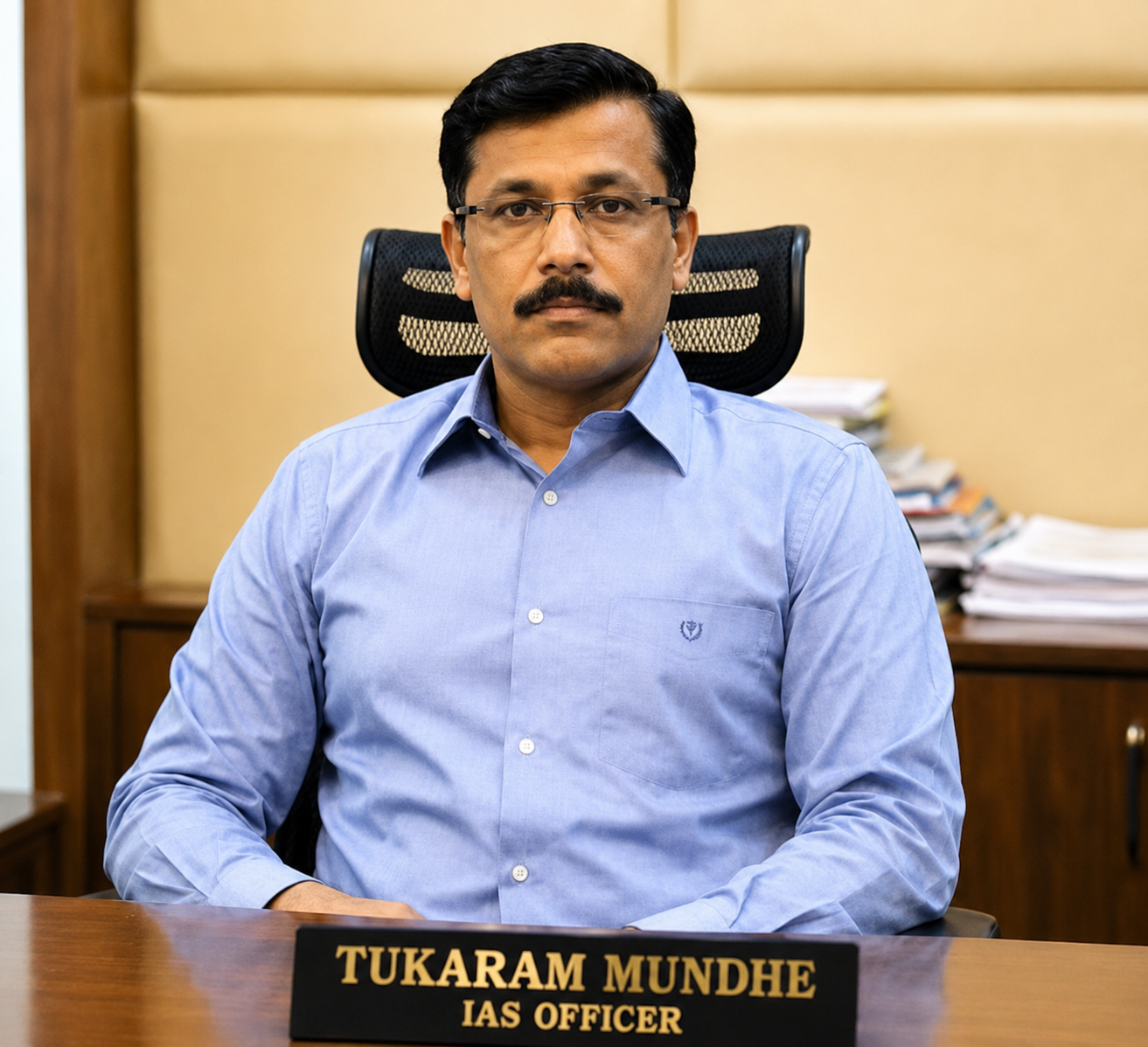
Ask anyone in Maharashtra’s bureaucracy about Tukaram Mundhe, and you’ll get an opinion fast. The 2005-batch IAS officer has picked up a nickname — “Singham,” after the no-nonsense movie cop — and it’s stuck for a reason. What sets him apart isn’t just that he cracks down on illegal construction or sand mining wherever he lands. It’s how often he lands somewhere new. Depending on who’s counting, he’s been transferred somewhere north of 20 times, maybe close to 25, in a career spanning roughly two decades. To a lot of ordinary people, that record reads as proof of an officer who won’t be pushed around. To plenty of politicians, it reads as a man who doesn’t know how to bend, even a little.
He didn’t start out anywhere near power. Mundhe was born on June 3, 1975, in Tadsonna, a small village in Beed district, part of Marathwada — a region that’s no stranger to drought and agrarian hardship. His family farmed, and like a lot of farming families in that belt, debt was a constant companion. As a kid, he split his time between schoolwork at the local Zilla Parishad school and helping out in the fields. Later he made his way to Aurangabad for college, earning a bachelor’s degree that combined history, political science, and sociology, then a master’s in political science from Dr. Babasaheb Ambedkar Marathwada University. An older brother already in government service seems to have nudged him toward the idea of civil service himself. He got through the Maharashtra Public Service Commission exam first, worked for a while as a Class II officer, and kept at it — eventually landing All India Rank 20 in the UPSC Civil Services Examination. That’s what got him into the IAS, Maharashtra cadre, in 2005.
His very first posting, as supernumerary assistant collector in Solapur, already hinted at what was coming: he went after illegal establishments almost immediately. That instinct followed him everywhere. He ran the zilla parishads in Nagpur and Washim as CEO, served as additional tribal commissioner in Nashik, and became collector of Jalna. From 2012 to 2014 he was joint commissioner of sales tax in Mumbai, a stretch where tax recovery numbers jumped noticeably. Then, in November 2014, he went back to Solapur — this time as district collector — and threw himself into water conservation work under the Jalyukt Shivar scheme, took on the sand mafia, and helped wean several villages off water tankers. The state gave him a best-collector award for 2015–16 for that work. From there it was Navi Mumbai as municipal commissioner, then chairman and managing director of Pune’s transport corporation (PMPML), then municipal commissioner of Nashik. Same themes everywhere: tighten the finances, enforce the building codes, run a cleaner shop.
“He rarely stayed anywhere longer than a year, sometimes eighteen months at most.”
But it’s the transfers themselves that really define the story. He rarely stayed anywhere longer than a year, sometimes eighteen months at most. Early on it was Solapur, then Degloor subdivision in Nanded, then Nagpur’s zilla parishad, a short stint in the tribal department, Washim, Jalna. After the sales tax posting and his second run in Solapur, things moved even faster — Navi Mumbai, Pune transport, Nashik, then a string of state-level jobs in planning and AIDS control. By January 2020 he was municipal commissioner of Nagpur, and that turned out to be one of his rockiest postings yet. Corporators from across the political spectrum pushed back hard on how he handled the civic budget, development spending, and his COVID-19 response, which some called too centralized for their taste. He himself caught COVID that year, and while still recovering, got transferred out — this time to the Maharashtra Jeevan Pradhikaran, in August 2020. After that came a scattering of roles: the state human rights commission, commissioner of health services, director of the National Health Mission, and a run of secretary-level postings covering animal husbandry, language policy, unorganised labour, and disability welfare. By mid-2026, he’d taken charge of Maharashtra’s Food and Drug Administration, where his enforcement drives against unhygienic food outlets and adulteration were, once again, making headlines.
How people react to all this depends a lot on where they’re standing. When he left Nashik, residents actually turned out to protest the transfer — they didn’t want him gone. In Solapur and elsewhere, locals point to real, visible improvements in water access and a drop in illegal extraction as reasons to credit him. Politicians tend to see it differently, often describing him as someone who won’t meet elected officials halfway. There have been accusations of heavy-handedness and overreach along the way too, even if the government has sometimes stood behind his record. And the transfers themselves have become part of how people talk about him — supporters treat each one as evidence he can’t be intimidated, while critics say a style that rigid was always going to create friction sooner or later.
“Supporters treat each transfer as evidence he can’t be intimidated — critics say a style that rigid was always going to create friction.”
What does his actual governing look like? Strict enforcement, an emphasis on transparency, and a habit of engaging directly with the public — things like randomised distribution systems designed to cut out middlemen, anti-encroachment drives, and initiatives like “Walk with the Commissioner,” meant to make him more reachable. In Nagpur, during COVID, he oversaw containment work and pointed to health outcomes that he said were better than average for the period — though that same stretch also sharpened his political conflicts. His supporters treat all of it as evidence of integrity. Critics counter that being this uncompromising about rules can slow things down and make it harder to keep colleagues and politicians on side — cooperation you often need if reforms are going to stick.
It’s not surprising that young civil service aspirants bring him up as an example of someone who kept doing the job his way even under political pressure. But his career also feeds into a bigger, more uncomfortable question: what happens to the relationship between career bureaucrats and the elected governments they serve when officers seen as independent keep getting shuffled around? Short postings make it hard to see any reform through to the end, and they can quietly discourage other officers from taking the same risks. At the same time, no one disputes that governments have a legitimate right to move officers based on administrative needs or, sometimes, political ones. That tension isn’t really about Mundhe as a person; it’s baked into the system itself. Whether all these transfers have actually blunted his effectiveness, or just made his story more visible, is hard to say for certain. Short tenures obviously limit what any officer can finish. But the fact that people like Mundhe keep doing things their way, transfer after transfer, despite the personal toll, says something too — that there’s still room in the civil service for people who put institutional principle ahead of career comfort. His career doesn’t settle the argument about bureaucratic independence in India. If anything, it just keeps the argument alive.
@Rohit Manral