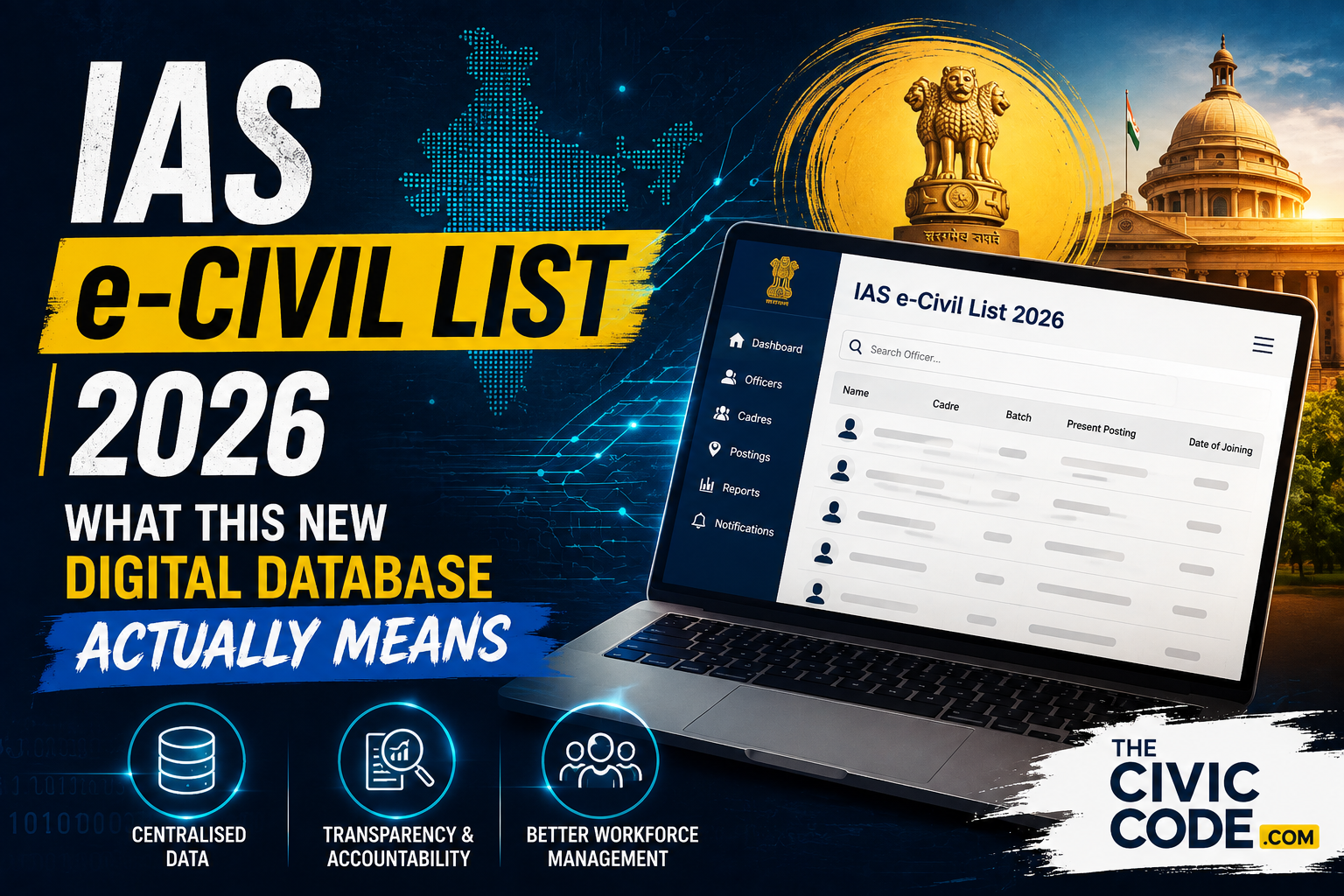
In June 2026, the Indian government made further progress in data-driven IAS management by introducing the IAS e-Civil List 2026. Dr Jitendra Singh, Union Minister of State (Independent Charge) for Science and Technology as well as Earth Sciences, along with his role as Minister of State for PMO, Personnel, Public Grievances, Pensions, Atomic Energy, and Space, officially unveiled it at Kartavya Bhawan in New Delhi. At first glance, it appeared to be yet another formal announcement. Beneath the surface, it indicates a subtle change in how the government monitors its high-ranking officials.
For years, the IAS Civil List essentially served as a printed (or later PDF) document showing who was assigned to which position. The 2026 edition transforms it into a fully digital, searchable database. It catalogues officers according to cadre and batch, their educational backgrounds, the types of work they’ve undertaken, their current positions, salary scales, and their retirement dates. It indicates the number of officers each cadre is meant to have and the actual number present.
The more interesting part is the talent-mapping angle.An IAS officer’s profession can transition from district duties to sectors like infrastructure, education, health, finance, rural development, or policy formulation. When all that expertise is consolidated in one location and made searchable, the government gains a better understanding of the skills present throughout the service.
The concept is simple. Improved data should simplify the planning process. If a department requires an individual with expertise in a specific area, they can search for it rather than depending solely on recollection or casual connections. The list alone doesn’t determine assignments, but it can inform decisions regarding personnel management, staffing strategies, and placement of individuals.
The figures are revealing.
The figures are revealing. As of 1 January 2026, a total of 5,755 IAS officers were employed in 25 different cadres. The approved strength is 7,026. Thus, a distinct gap exists. The list additionally marks officers projected to retire within the next five years. Having that type of proactive perspective allows the government to consider openings before they become available.
This aligns with a broader trend. Digital tools are no longer exclusively for public services. They are also beginning to be utilised for the government’s internal administration. Transforming the Civil List into an active database is one illustration of that transformation.
The online format significantly enhances accessibility for researchers, civil service aspirants, and anyone curious about the system’s operation. A more transparent understanding of who is accessible and what they have achieved will truly benefit ministries and state officials.
Naturally, a database’s quality relies on its updates and how it is utilised. When the data remains up-to-date and individuals truly reference it during planning, it can turn into a valuable resource. If it is left untouched, it stays merely an additional digital file.
Understanding who possesses what skills, where individuals are currently allocated, and where future staffing shortages might occur could become more critical for an organisation that manages thousands of officers across the country. This is the point where the e-Civil List can evolve from a digital file into a valuable tool for modern civil service management.
In the end, the IAS e-Civil list 2026 is ultimately a component of a broader effort to integrate data with workforce planning. In June 2026, this list was formally introduced.What matters now is how the information is utilised in everyday decisions related to India’s administrative services.
@Rohit Manral