Does being ‘faceless’ in the government system mean being ‘accountability-less’?
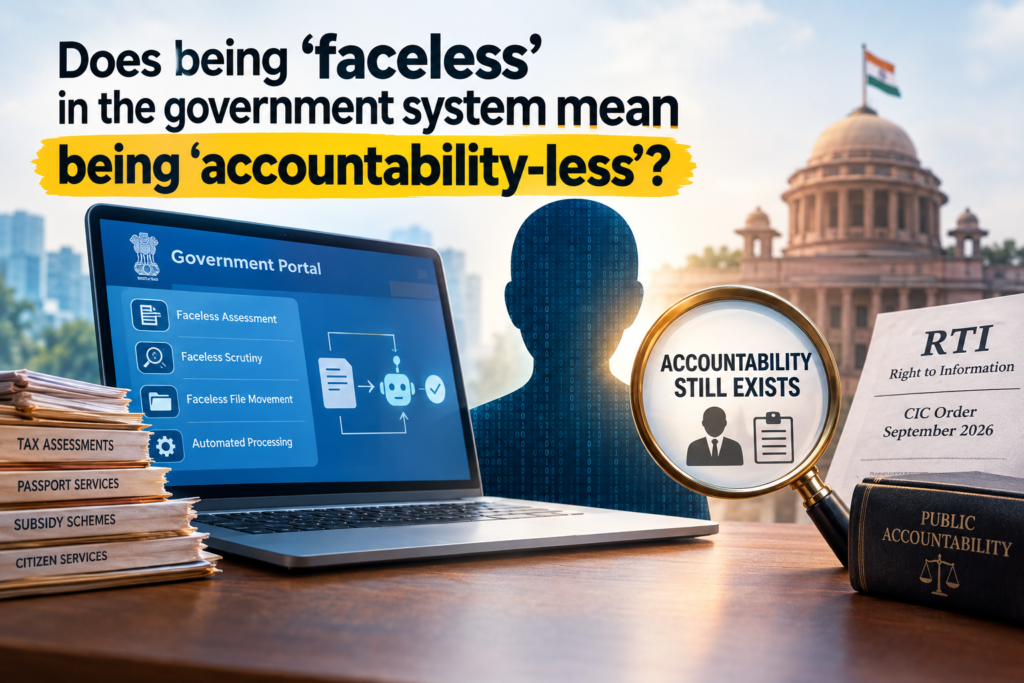
We keep hearing this word everywhere now — faceless. Faceless assessment, faceless scrutiny, faceless file movement, faceless everything. On paper it sounds clean. No face-to-face, no middlemen, less chance of someone asking for chai-paani. The machine does the work, the portal decides, the algorithm moves the file. Everyone claps. But here’s the real question that keeps coming back: when something goes wrong, who do you hold accountable? In September 2026, the Central Information Commission dealt with an RTI matter and said something that should have been obvious but somehow needed saying out loud. Automated or faceless administration cannot wipe out responsibility. Accountability does not disappear just because a human face is no longer visible on the file. That one line cuts through a lot of the current confusion. Think about how many people file RTIs these days only to get replies that basically say, “The system generated it,” or “It was processed under the faceless scheme,” or “No individual officer is involved.” It feels neat and technical. It also feels like a perfect escape route. The moment you remove the person, you also try to remove the responsibility that person carried. But systems don’t run themselves. Someone designs the rules the system follows. Someone decides which data goes in, which parameters matter, which exceptions are allowed, and when a case gets escalated. Someone sits in the control room even if the public never sees their name. Faceless does not mean ownerless. The CIC’s point was simple and sharp. You can automate the process. You cannot automate away the duty to answer for the outcome. If an order is wrong, if a file is delayed beyond reason, if a citizen is denied something they were entitled to, the public still has the right to know who decided what and on what basis. The RTI Act was never meant to stop at the edge of a software interface. We have seen this tension play out in tax assessments for years. Faceless assessments were sold as the end of harassment. In many cases they did reduce unnecessary meetings. Yet when a high-pitched demand comes or a genuine explanation is ignored, the assessee is left talking to a faceless unit. The same pattern is slowly spreading to other departments. Passport work, certain subsidy schemes, some service delivery portals — the human is being removed from the frame, and with it the easy trail of responsibility. That is dangerous. Accountability is not a luxury. It is the only thing that keeps power from becoming casual. When an officer knows that one day someone can ask, “Why did you take this decision?” the quality of decisions improves. When the same officer can hide behind “the system did it,” the quality starts slipping. Mistakes stop getting fixed. Patterns of error stop getting noticed. Citizens stop believing the process is fair. Some people argue that technology is neutral. It isn’t. Technology reflects the priorities of the people who build and manage it. If those people are not answerable, the technology becomes a shield instead of a tool. The CIC order simply refused to accept that shield as permanent. There is another layer to this. Faceless systems generate huge amounts of data and logs. In theory, those logs should make accountability stronger, not weaker. You should be able to pull up exactly when a decision was taken, which rule was applied, which officer last touched the case, and what the system recorded as the reason. But that only happens if the department is willing to treat those logs as public records under the RTI Act and not as internal technical details that citizens have no business seeing. Many still treat them as the latter. The September decision pushes in the opposite direction. It reminds public authorities that the shift to automated administration does not rewrite the basic compact between citizen and state. You can change the method of work. You cannot change the fact that the work is still being done in the name of the people and with public money. Therefore the people still get to ask questions. This is not an argument against technology. Nobody serious is saying we should go back to paper files and long queues for everything. Speed and reduced physical interface have real value. The argument is narrower and more important: do not use “faceless” as a synonym for “no one is responsible.” In the end it comes down to a simple test. If a citizen is harmed by an automated decision, is there a clear path to find out who owns that decision and how it can be corrected? If the answer is no, then the system has failed the purpose of public administration. If the answer is yes, then faceless can work. The CIC has now put it on record that the second answer is the only acceptable one. Automated processes are allowed. Accountability-less processes are not. That is not a technical observation. That is a democratic one. And it needed saying. Publisher By – Rohit Manral Written By – Anjali Pandey
That Quiet Shift from Files to Feeling Heard
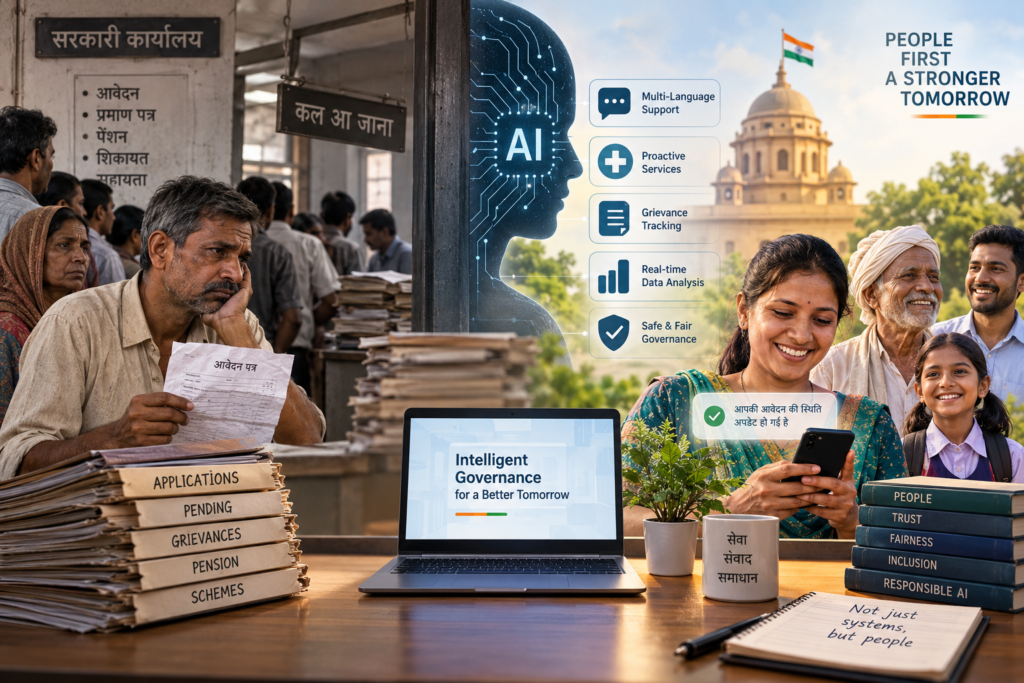
Standing outside some government office with a crumpled form, wondering if the person inside will even look up. For years they told us everything would get better once it all went online. Portals came. Apps came. Still the same long waits, the same “come tomorrow,” the same sense that you are just another number in a long list. Something different is starting to happen now. I was reading about the Technology Sabha that took place in Jaipur in August this year. People there were not talking about building yet another website. They were talking about making the whole system a little more intelligent, a little more human. They called it intelligent governance. Not the flashy kind. The kind that tries to understand the person standing in front of it. Think about the farmer who files the same complaint three times before anyone notices the crop has failed. Or the widow who keeps visiting the same counter for months because her pension papers are “under process.” These are not policy points in a report. These are real afternoons that stretch into evenings. The idea floating around at that Sabha is that AI can help cut through some of that. In the day-to-day work of public services, you already see small changes. A system that answers in the language you actually speak, not just the official one. Tools that notice when medicines are running low in a particular primary health centre and flag it before the queue forms. And those agentic systems they kept mentioning — ones that can take a grievance and keep following it from desk to desk until someone actually closes it. No more files sitting quietly in a tray for weeks. Policy-making is feeling the same pull. Instead of waiting for a survey that arrives two years late, officers can look at patterns as they happen — where people are moving, which schools are empty, which fields are drying up — and adjust while there is still time. Data analysis that used to need a whole room of people can now surface the important bits faster. But numbers can also flatten people. That is why the new India AI Governance Guidelines keep coming back to simple things: people first, trust, fairness. They set up groups to watch over the whole process — an AI Governance Group, a safety institute — because citizen data is not something to play with. Grievance redressal is where it gets personal for most of us. How many times have you sent a complaint into the system and watched it disappear? The hope is that these new tools can keep the matter alive, push it to the right person, and even send back a clear reply in the language you used when you first wrote. When they spoke at the Sabha about generating replies in more than twenty languages, I thought of the mother in a village who no longer has to ask her neighbour to read the update on her child’s scholarship. None of this is magic. The same guidelines that open the door also put up guardrails. Recent rules around deepfakes and synthetic content — the three-hour window to take things down, the labelling requirements — show they know the same tools can be misused. And the civil servants who will actually run all this? Many of them joined because they wanted to solve problems, not manage portals. Training is already happening. Programmes at places like LBSNAA are helping senior officers get comfortable with these tools. And right now, events like Guru Samvaad are bringing young aspirants face to face with serving officers and ministers. The questions those young people ask about fairness and the last person in the queue matter more than any presentation slide. Intelligent governance will not remove every long queue or every hard day. A machine cannot feel the weight of someone’s worry. But it can free an officer from endless paper-shuffling so there is time left to listen. It can surface the quiet cases that used to get lost. It can make the system feel a little less like a wall and a little more like something that remembers you came. The real test will not be how clever the models become. It will be whether the next time someone walks into a tehsil office, they leave feeling the system was at least trying to meet them halfway. If that happens for even a few more people than before, then the conversations that took place in Jaipur this August will have been worth having. We are not handing the reins to machines. We are trying to give people better tools so they can serve each other a little more carefully. That feels like something worth talking about, quietly, one person at a time. @Rohit Manral
IAS e-Civil List 2026: What This New Digital Database Actually Means
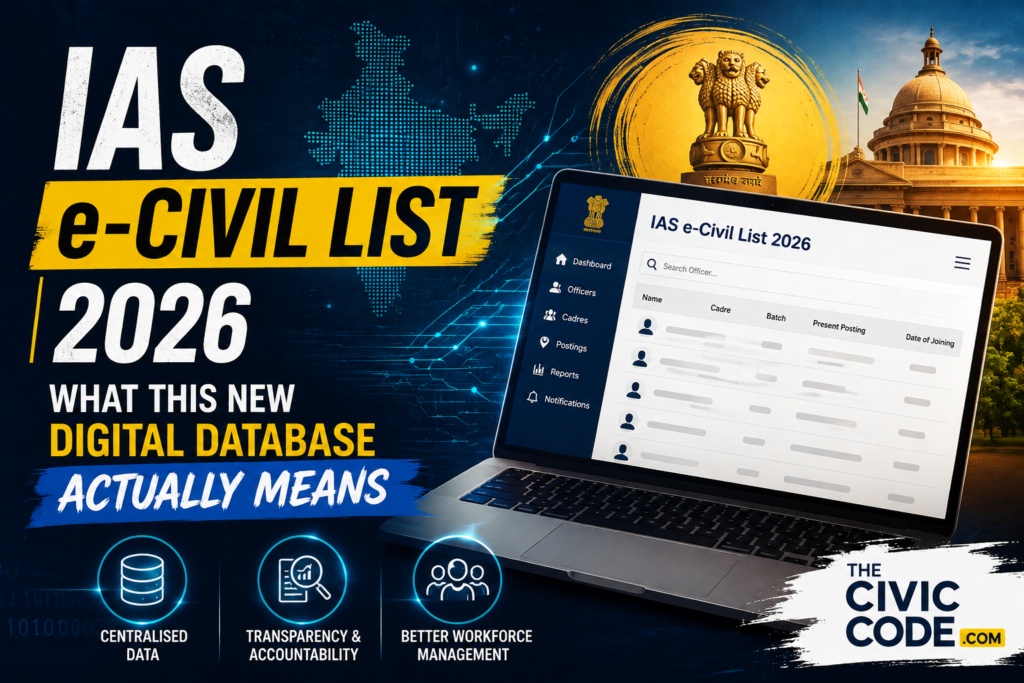
In June 2026, the Indian government made further progress in data-driven IAS management by introducing the IAS e-Civil List 2026. Dr Jitendra Singh, Union Minister of State (Independent Charge) for Science and Technology as well as Earth Sciences, along with his role as Minister of State for PMO, Personnel, Public Grievances, Pensions, Atomic Energy, and Space, officially unveiled it at Kartavya Bhawan in New Delhi. At first glance, it appeared to be yet another formal announcement. Beneath the surface, it indicates a subtle change in how the government monitors its high-ranking officials. For years, the IAS Civil List essentially served as a printed (or later PDF) document showing who was assigned to which position. The 2026 edition transforms it into a fully digital, searchable database. It catalogues officers according to cadre and batch, their educational backgrounds, the types of work they’ve undertaken, their current positions, salary scales, and their retirement dates. It indicates the number of officers each cadre is meant to have and the actual number present. The more interesting part is the talent-mapping angle.An IAS officer’s profession can transition from district duties to sectors like infrastructure, education, health, finance, rural development, or policy formulation. When all that expertise is consolidated in one location and made searchable, the government gains a better understanding of the skills present throughout the service. The concept is simple. Improved data should simplify the planning process. If a department requires an individual with expertise in a specific area, they can search for it rather than depending solely on recollection or casual connections. The list alone doesn’t determine assignments, but it can inform decisions regarding personnel management, staffing strategies, and placement of individuals.The figures are revealing. The figures are revealing. As of 1 January 2026, a total of 5,755 IAS officers were employed in 25 different cadres. The approved strength is 7,026. Thus, a distinct gap exists. The list additionally marks officers projected to retire within the next five years. Having that type of proactive perspective allows the government to consider openings before they become available. This aligns with a broader trend. Digital tools are no longer exclusively for public services. They are also beginning to be utilised for the government’s internal administration. Transforming the Civil List into an active database is one illustration of that transformation. The online format significantly enhances accessibility for researchers, civil service aspirants, and anyone curious about the system’s operation. A more transparent understanding of who is accessible and what they have achieved will truly benefit ministries and state officials. Naturally, a database’s quality relies on its updates and how it is utilised. When the data remains up-to-date and individuals truly reference it during planning, it can turn into a valuable resource. If it is left untouched, it stays merely an additional digital file. Understanding who possesses what skills, where individuals are currently allocated, and where future staffing shortages might occur could become more critical for an organisation that manages thousands of officers across the country. This is the point where the e-Civil List can evolve from a digital file into a valuable tool for modern civil service management. In the end, the IAS e-Civil list 2026 is ultimately a component of a broader effort to integrate data with workforce planning. In June 2026, this list was formally introduced.What matters now is how the information is utilised in everyday decisions related to India’s administrative services. @Rohit Manral