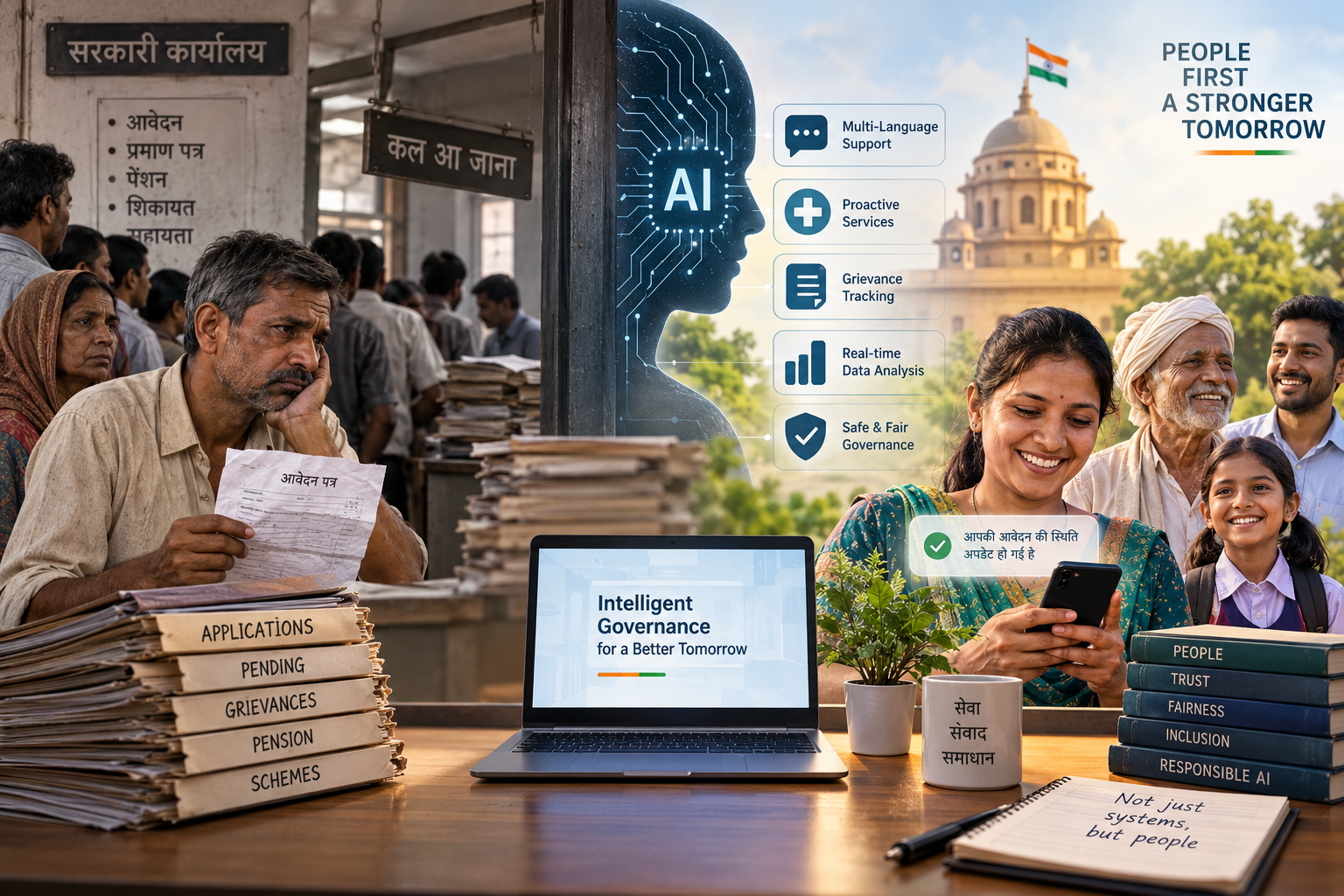
Standing outside some government office with a crumpled form, wondering if the person inside will even look up. For years they told us everything would get better once it all went online. Portals came. Apps came. Still the same long waits, the same “come tomorrow,” the same sense that you are just another number in a long list.
Something different is starting to happen now. I was reading about the Technology Sabha that took place in Jaipur in August this year. People there were not talking about building yet another website. They were talking about making the whole system a little more intelligent, a little more human. They called it intelligent governance. Not the flashy kind. The kind that tries to understand the person standing in front of it.
Think about the farmer who files the same complaint three times before anyone notices the crop has failed. Or the widow who keeps visiting the same counter for months because her pension papers are “under process.” These are not policy points in a report. These are real afternoons that stretch into evenings. The idea floating around at that Sabha is that AI can help cut through some of that.
In the day-to-day work of public services, you already see small changes. A system that answers in the language you actually speak, not just the official one. Tools that notice when medicines are running low in a particular primary health centre and flag it before the queue forms. And those agentic systems they kept mentioning — ones that can take a grievance and keep following it from desk to desk until someone actually closes it. No more files sitting quietly in a tray for weeks.
Policy-making is feeling the same pull. Instead of waiting for a survey that arrives two years late, officers can look at patterns as they happen — where people are moving, which schools are empty, which fields are drying up — and adjust while there is still time. Data analysis that used to need a whole room of people can now surface the important bits faster. But numbers can also flatten people. That is why the new India AI Governance Guidelines keep coming back to simple things: people first, trust, fairness. They set up groups to watch over the whole process — an AI Governance Group, a safety institute — because citizen data is not something to play with.
Grievance redressal is where it gets personal for most of us. How many times have you sent a complaint into the system and watched it disappear? The hope is that these new tools can keep the matter alive, push it to the right person, and even send back a clear reply in the language you used when you first wrote. When they spoke at the Sabha about generating replies in more than twenty languages, I thought of the mother in a village who no longer has to ask her neighbour to read the update on her child’s scholarship.
None of this is magic. The same guidelines that open the door also put up guardrails. Recent rules around deepfakes and synthetic content — the three-hour window to take things down, the labelling requirements — show they know the same tools can be misused. And the civil servants who will actually run all this? Many of them joined because they wanted to solve problems, not manage portals. Training is already happening. Programmes at places like LBSNAA are helping senior officers get comfortable with these tools. And right now, events like Guru Samvaad are bringing young aspirants face to face with serving officers and ministers. The questions those young people ask about fairness and the last person in the queue matter more than any presentation slide.
Intelligent governance will not remove every long queue or every hard day. A machine cannot feel the weight of someone’s worry. But it can free an officer from endless paper-shuffling so there is time left to listen. It can surface the quiet cases that used to get lost. It can make the system feel a little less like a wall and a little more like something that remembers you came.
The real test will not be how clever the models become. It will be whether the next time someone walks into a tehsil office, they leave feeling the system was at least trying to meet them halfway. If that happens for even a few more people than before, then the conversations that took place in Jaipur this August will have been worth having.
We are not handing the reins to machines. We are trying to give people better tools so they can serve each other a little more carefully. That feels like something worth talking about, quietly, one person at a time.
@Rohit Manral