That Quiet Shift from Files to Feeling Heard
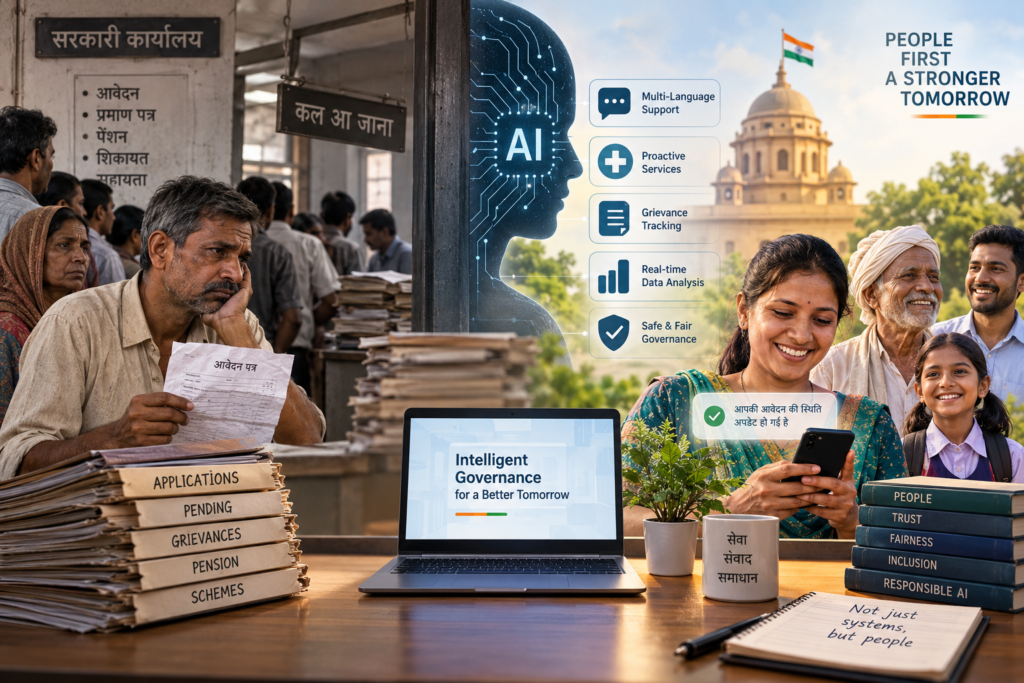
Standing outside some government office with a crumpled form, wondering if the person inside will even look up. For years they told us everything would get better once it all went online. Portals came. Apps came. Still the same long waits, the same “come tomorrow,” the same sense that you are just another number in a long list. Something different is starting to happen now. I was reading about the Technology Sabha that took place in Jaipur in August this year. People there were not talking about building yet another website. They were talking about making the whole system a little more intelligent, a little more human. They called it intelligent governance. Not the flashy kind. The kind that tries to understand the person standing in front of it. Think about the farmer who files the same complaint three times before anyone notices the crop has failed. Or the widow who keeps visiting the same counter for months because her pension papers are “under process.” These are not policy points in a report. These are real afternoons that stretch into evenings. The idea floating around at that Sabha is that AI can help cut through some of that. In the day-to-day work of public services, you already see small changes. A system that answers in the language you actually speak, not just the official one. Tools that notice when medicines are running low in a particular primary health centre and flag it before the queue forms. And those agentic systems they kept mentioning — ones that can take a grievance and keep following it from desk to desk until someone actually closes it. No more files sitting quietly in a tray for weeks. Policy-making is feeling the same pull. Instead of waiting for a survey that arrives two years late, officers can look at patterns as they happen — where people are moving, which schools are empty, which fields are drying up — and adjust while there is still time. Data analysis that used to need a whole room of people can now surface the important bits faster. But numbers can also flatten people. That is why the new India AI Governance Guidelines keep coming back to simple things: people first, trust, fairness. They set up groups to watch over the whole process — an AI Governance Group, a safety institute — because citizen data is not something to play with. Grievance redressal is where it gets personal for most of us. How many times have you sent a complaint into the system and watched it disappear? The hope is that these new tools can keep the matter alive, push it to the right person, and even send back a clear reply in the language you used when you first wrote. When they spoke at the Sabha about generating replies in more than twenty languages, I thought of the mother in a village who no longer has to ask her neighbour to read the update on her child’s scholarship. None of this is magic. The same guidelines that open the door also put up guardrails. Recent rules around deepfakes and synthetic content — the three-hour window to take things down, the labelling requirements — show they know the same tools can be misused. And the civil servants who will actually run all this? Many of them joined because they wanted to solve problems, not manage portals. Training is already happening. Programmes at places like LBSNAA are helping senior officers get comfortable with these tools. And right now, events like Guru Samvaad are bringing young aspirants face to face with serving officers and ministers. The questions those young people ask about fairness and the last person in the queue matter more than any presentation slide. Intelligent governance will not remove every long queue or every hard day. A machine cannot feel the weight of someone’s worry. But it can free an officer from endless paper-shuffling so there is time left to listen. It can surface the quiet cases that used to get lost. It can make the system feel a little less like a wall and a little more like something that remembers you came. The real test will not be how clever the models become. It will be whether the next time someone walks into a tehsil office, they leave feeling the system was at least trying to meet them halfway. If that happens for even a few more people than before, then the conversations that took place in Jaipur this August will have been worth having. We are not handing the reins to machines. We are trying to give people better tools so they can serve each other a little more carefully. That feels like something worth talking about, quietly, one person at a time. @Rohit Manral
Why India Needs a Fresh Approach to Bureaucratic Accountability
There’s a phrase almost every Indian who has ever dealt with a government office has heard: “It’s still under process.” You hear it when a pension check is late, when a property transfer is stalled, when an income certificate never shows up, or when a complaint about some public service has been gathering dust for weeks. You file your paperwork, get a receipt, and then the waiting starts. One trip, you’re told the file is with a clerk. Next time, it’s moved to a section officer’s desk. A while later, it’s “pending approval.” Ask when it’ll actually be resolved, and nobody seems to know. Come back tomorrow. So you do. It might look like a minor annoyance on its own. But multiply it by millions of citizens, and it reveals something much bigger about how the Indian state thinks about accountability. When something gets held up in government, who’s actually on the hook for the delay? India’s administrative system has always leaned heavily on hierarchy, procedure, and rule-following. Files pass through set channels. Every decision needs a note, then a sign-off. Rules spell out who can act and when. There’s a real reason for that. No government can run purely on individual judgment calls. Rules bring consistency, guard public money, and prevent arbitrary decision-making. In a country as vast and complicated as India, procedural discipline matters. The trouble starts when following the procedure becomes the whole point, instead of a means to an end. A certificate that takes three months might have gone through every required approval, perfectly in line with protocol. A complaint might get logged, forwarded, and reviewed — and the actual problem might still be sitting there, unsolved. From the department’s point of view, the file moved. From the citizen’s point of view, nothing changed. That gap deserves a lot more attention than it gets. Still, the answer isn’t to paint bureaucrats as lazy or careless — that story is too easy, and usually wrong. Government officers work inside a system where every choice can be second-guessed from multiple directions. Rules are often tangled, staffing is thin, responsibilities overlap, and a decision made in good faith can be picked apart years later. In that kind of environment, it makes sense to play it safe. If deciding something carries more personal risk than putting it off does, delay becomes the logical move. Passing a file upward feels safer than deciding on it. Asking for “one more clarification” feels safer than using judgment. Waiting on a superior’s sign-off feels safer than being the one who owns the call. Over time, that builds a culture where playing it procedurally safe gets rewarded more often than taking initiative. That’s the piece of India’s accountability model that needs to change. The goal isn’t more oversight — it’s smarter oversight. First, responsibility needs to be clearer. A citizen shouldn’t have to decode an internal chain of command just to find out who’s handling their case. If something is pending, people deserve to know its current status, who’s responsible next, and roughly when to expect resolution. A published timeline shouldn’t be treated as optional — and when delays are unavoidable, the reason should be stated plainly. That single shift would make administrative delay something you can actually trace back to a source. Second — and just as important — performance shouldn’t be judged solely on whether the rulebook was followed. It also has to account for whether the outcome was actually achieved. That doesn’t mean scrapping procedural safeguards. It means treating procedure as the tool, not the goal itself. If a pension gets approved correctly on paper but reaches an elderly person months late, that’s not really a success story. If a grievance gets marked “resolved” in the system while the underlying issue is still unfixed, a closed file isn’t the same thing as a solved problem. For the person on the other end, this isn’t an abstract distinction. It touches their income, their access to basic services, their property, their job, and sometimes just their dignity. But shifting toward outcome-based accountability needs a safety net too: officers have to be free to make honest calls without living under constant threat of being punished after the fact. A system that comes down hard on every mistake doesn’t necessarily produce better governance — it might do the opposite. Officers stop wanting to decide anything. Files keep getting bumped upward. Choices get postponed. Responsibility gets spread so thin nobody really holds it. The end result: a bureaucracy that looks accountable on paper but is functionally stuck. So there needs to be a real distinction between deliberate wrongdoing, repeated failure to act, and an honest decision that simply didn’t pan out the way anyone hoped. Accountability should build a sense of ownership — not fear. There’s also a strong case for putting the citizen’s actual experience closer to the center of how government performance gets judged. Departments already track plenty of data — applications received, disposal rates, targets hit. But numbers can hide more than they reveal. A department might report that it “disposed of” thousands of applications. That’s a data point. It doesn’t tell you whether those cases were handled fairly, resolved in a reasonable time, or whether people had to keep showing up in person to get anything done. But shifting toward outcome-based accountability needs a safety net too: officers have to be free to make honest calls without living under constant threat of being punished after the fact. A system that comes down hard on every mistake doesn’t necessarily produce better governance — it might do the opposite. Officers stop wanting to decide anything. Files keep getting bumped upward. Choices get postponed. Responsibility gets spread so thin nobody really holds it. The end result: a bureaucracy that looks accountable on paper but is functionally stuck. So there needs to be a real distinction between deliberate wrongdoing, repeated failure to act, and an honest decision that simply didn’t pan out the way anyone hoped.