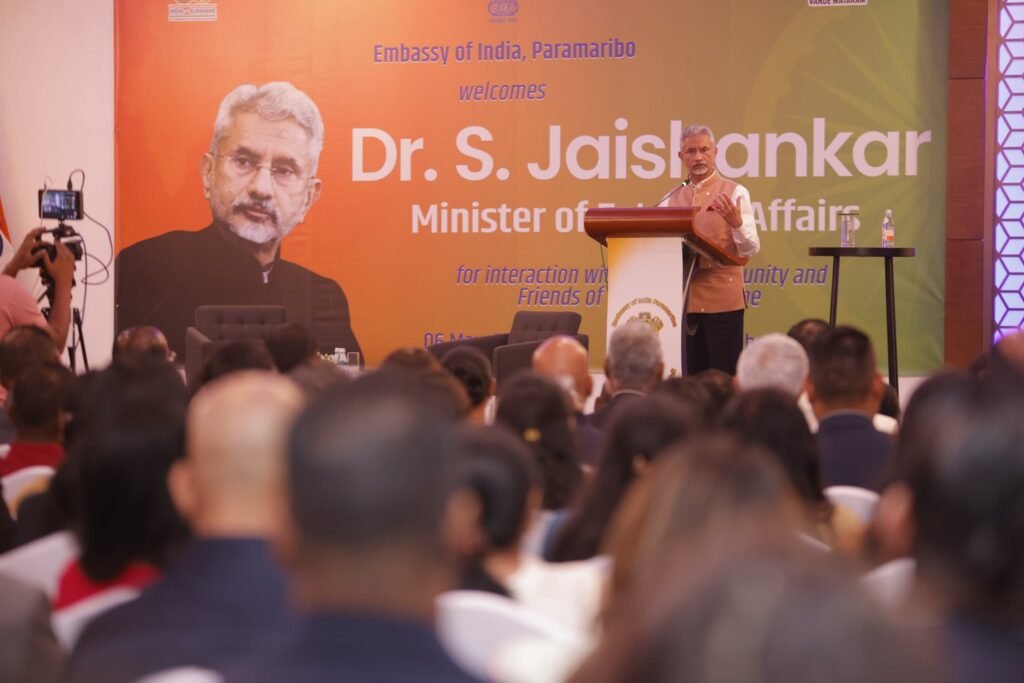
Subrahmanyam Jaishankar is an Indian diplomat and politician who is currently serving as the External Affairs Minister of India. Born on 9 January 1955 in Delhi, he joined the Indian Foreign Service in 1977 and held important diplomatic positions in countries like the United States, China, and Czech Republic. He became India’s Foreign Minister in 2019 and is known for his strong role in shaping India’s foreign policy and international relations.
Diplomatic Career (1977-2018)
Subrahmanyam Jaishankar joined Indian Foreign Service (IFS) in 1977 and served as a career diplomat for over four decades. He served in several important diplomatic positions in countries such as Russia, United States, Sri Lanka, Hungary, and Japan. He also worked in India’s Ministry of External Affairs and served as press secretary to former President Shankar Dayal Sharma. In 2000, he became India’s ambassador to the Czech Republic. Later, he played an important role in the 2005 Indo-U.S. civil nuclear deal and served as India’s High Commissioner to Singapore from 2007 to 2009.
Ambassador of Czech Republic (2001-2004)
Subrahmanyam Jaishankar served as India’s Ambassador to the Czech Republic from 2001 to 2004. During his tenure, he worked to strengthen diplomatic, economic, and cultural relations between India and the Czech Republic. He focused on improving trade cooperation, promoting Indian interests in Central Europe, and expanding bilateral ties between the two countries.
Joint secretary at Ministry (2004-2007)
S. Jaishankar served as Joint Secretary in India’s Ministry of External Affairs from 2004 to 2007. During this period, he handled important matters related to India’s relationship with the United States.He played a major role in negotiating the historic India–US Civil Nuclear Agreement, which helped improve cooperation between the two countries in nuclear energy and strategic affairs. His work during this time strengthened diplomatic ties between India and the United States and increased India’s global influence.
Higher Commissioner to Singapore(2007-2009)
From 2007 to 2009, S. Jaishankar served as India’s High Commissioner to Singapore. During his tenure, he worked to strengthen economic, strategic and cultural ties between the two countries.He helped implement the Comprehensive Economic Cooperation Agreement (CECA), which increased trade, investment and business cooperation between India and Singapore. He also oversaw a defence arrangement that allowed Singapore to keep some of its military equipment and training facilities in India.
Jaishankar promoted closer people-to-people relations and encouraged the participation of the Indian community in Singapore through events like Pravasi Bharatiya Divas. His work further improved Singapore’s role as an important economic and strategic partner for India.
Ambassador of China (2009-2013)
S. Jaishankar served as India’s ambassador to China from 2009 to 2013, becoming India’s longest-serving envoy there. During his tenure, he worked to strengthen trade, economic and cultural ties while also handling sensitive border disputes between the two countries.
He played a key role in resolving several diplomatic issues, including China’s stapled visa policy for people from Jammu and Kashmir and tensions over Chinese maps showing Arunachal Pradesh and Aksai Chin as Chinese territory. In 2013, he helped defuse the Depsang Plains standoff in Ladakh before Chinese Premier Li Keqiang visited India.Jaishankar also promoted stronger cooperation with China while insisting that India’s core interests and balanced trade relations be respected.
Ambassador to the USA(2013-2014)
S. Jaishankar became India’s Ambassador to the United States in September 2013 and officially took charge in December that year, succeeding Nirupama Rao.He arrived during the sensitive Devyani Khobragade incident and helped negotiate the Indian diplomat’s exit from the United States, which eased tensions between the two countries.In 2014, Jaishankar spoke at the Carnegie Endowment for International Peace, where he said India–US relations were strong but needed better public understanding. He also formally presented his diplomatic credentials to then US President Barack Obama at the White House.
Jaishankar played an important role in organising Prime Minister Narendra Modi’s first visit to the United States in September 2014 and helped strengthen ties with the Indian-American community.
Foreign Secretary (2015-2018)
S. Jaishankar was appointed India’s Foreign Secretary on 29 January 2015 during the government of Narendra Modi. His appointment was announced after a meeting of the Cabinet Appointments Committee.His selection was unusual because it came just three days before his retirement date and also ended the tenure of then Foreign Secretary Sujatha Singh before her term was completed.
During his time as Foreign Secretary, the working style of the Ministry of External Affairs changed significantly and became more active in diplomacy. However, some analysts in Nepal criticised him over the 2015 Nepal blockade issue and called him one of its main planners. His tenure ended in January 2018.
President of global corporate affairs with tata groups (2018-2019)
After completing his term as Foreign Secretary in 2018, S. Jaishankar joined Tata Sons. as the President of Global Corporate Affairs. In this role, he handled the company’s international relations and global business strategies. He worked on strengthening Tata Group’s connections with foreign governments, international organizations and global business partners. His diplomatic experience helped the company manage international affairs and expand its global presence. However, he held this position for only a short time because in 2019 he entered politics and became India’s External Affairs Minister in the government led by Narendra Modi.
Ministry of external affairs Since (2019 -present) Member of BJP
S. Jaishankar became a member of the Rajya Sabha in July 2019 during the second government of Narendra Modi. He was elected from the state of Gujarat as a representative of the Bharatiya Janata Party (BJP). After joining Parliament, he continued serving as India’s External Affairs Minister in the government led by Narendra Modi . In the Rajya Sabha, he has spoken on important foreign policy matters, including India’s relations with neighboring countries, global diplomacy, trade, and national security.
He was the first former Foreign Secretary to later lead the Ministry of External Affairs as a Cabinet Minister.As minister, Jaishankar played an important role in strengthening India’s foreign relations and security partnerships. In 2020 he signed the BECA defence agreement with the United States along with Defence Minister Rajnath Singh. The agreement improved intelligence and geospatial information sharing between India and the US.Jaishankar strongly defended India’s independent foreign policy during the Russian invasion of Ukraine. He supported continued relations with Russia, defended India’s purchase of Russian oil, and criticised what he called Europe’s “double standards.” He also called Russia a reliable and long-term partner of India. On relations with China, Jaishankar said tensions increased because China did not follow earlier border agreements, though he continued diplomatic engagement to maintain stability. He also stressed that India would continue business with China carefully and according to national interests.
Jaishankar has taken a tough stand on Pakistan, repeatedly raising concerns about cross-border terrorism. He called Pakistan the“epicentre of terrorism”and criticised its support for terror groups. During meetings such as the Shanghai Cooperation Organisation summit, he openly challenged Pakistani leaders on terrorism issues.He also commented on global conflicts such as the Israel–Hamas war, condemning terrorism while supporting a peaceful two-state solution for Israelis and Palestinians. Overall, Jaishankar’s tenure as External Affairs Minister has been marked by assertive diplomacy, strategic partnerships and a focus on protecting India’s national interests.
In 2019 the Indian government awarded him the Padma Shri,the country’s fourth highest civilian honour.