
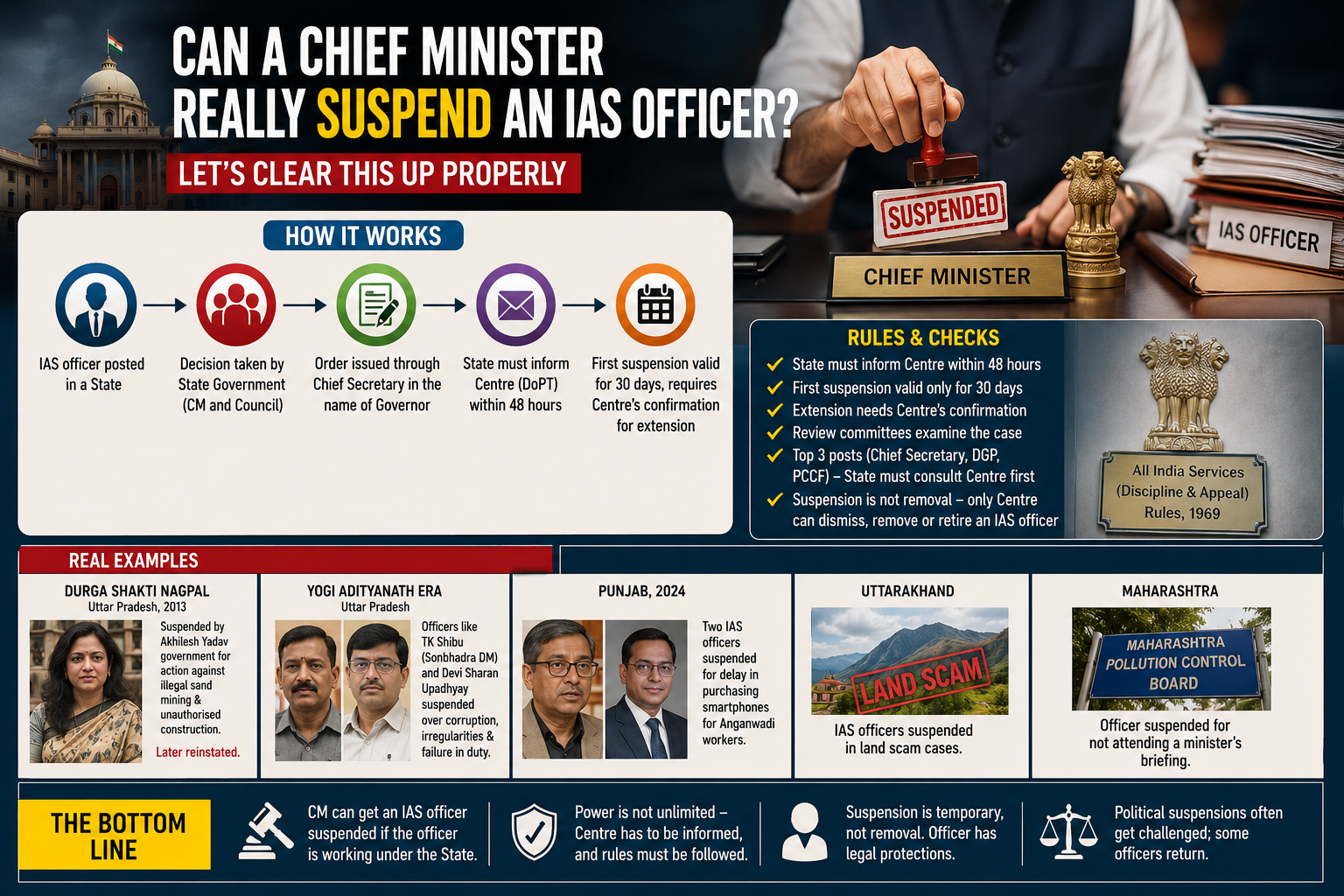
You know how this question keeps popping up every time some officer gets into trouble with the state government? People start saying “CM can do anything” or the opposite “no one can touch IAS officers.” Both are half-true. Let me tell you exactly how it works, without any fancy language.
IAS officers are All India Service people. They are appointed by the Centre but when they are posted in a state, they work under that state government. The rule that matters most is the All India Services (Discipline and Appeal) Rules of 1969. Under those rules, the state government can suspend an IAS officer. And the state government means the Chief Minister and his team. The order usually comes through the Chief Secretary, but the decision is political and administrative, and it sits with the CM.
It is not like the CM picks up a pen and writes “you are suspended.” The proper channel is followed, the file moves, and the order is issued in the name of the Governor. But make no mistake—if the Chief Minister wants it done, it gets done. Courts have accepted this. There was a case in Kerala where the tribunal clearly said the Chief Minister had the power to place an All India Service officer under suspension under the rules of business.
Now the important part that most people miss: there are checks. After 2015 the rules became tighter. The moment a state suspends an IAS officer, they have to inform the Centre (DoPT) within 48 hours. The first suspension order is valid only for 30 days. If they want to keep the officer suspended longer, they need the Centre’s confirmation. After that, review committees look at it. You cannot keep someone hanging forever without proper process. For the top three posts—Chief Secretary, DGP and Principal Chief Conservator of Forests—the state cannot act without taking the Centre into confidence first.
Suspension is temporary. It is not removal. The state can never throw an IAS officer out of service completely. Dismissal, removal or compulsory retirement can only be done by the Central Government. That is why many suspended officers come back after inquiry or after the political temperature cools.
Look at real examples. In 2013, Durga Shakti Nagpal was suspended by the Akhilesh Yadav government in Uttar Pradesh. She had been cracking down hard on illegal sand mining and had also taken action against an unauthorised construction. The suspension happened fast and became big news. Later she was reinstated.
In Uttar Pradesh under Yogi Adityanath, several officers have been suspended over the years—TK Shibu when he was DM of Sonbhadra, Devi Sharan Upadhyay, and others—mostly on charges of corruption, irregular decisions or failure in duty. The state government issues the order, informs the Centre, and the process moves.
Punjab recently suspended two IAS officers over delay in buying smartphones for Anganwadi workers. The orders specifically mentioned Rule 3 of the AIS rules. Uttarakhand has done the same in land scam cases. Maharashtra suspended an officer from the Pollution Control Board for not attending a minister’s briefing. Same pattern everywhere.
So the simple truth is this: yes, a Chief Minister can get an IAS officer suspended if the officer is working under the state. It happens regularly. But the power is not unlimited. The Centre has to be informed, the suspension has a time limit unless extended properly, and the officer still has protection under the Constitution and the rules. That is why some officers get reinstated later, and why completely political suspensions sometimes get challenged successfully in the tribunal or court.
That is how the system actually works. Not absolute power, not zero power just a controlled power that both sides keep testing.
@Rohit Manral