The District Magistrate in the Age of Digital Governance— When citizens can access services online, what should the modern DM actually be responsible for?
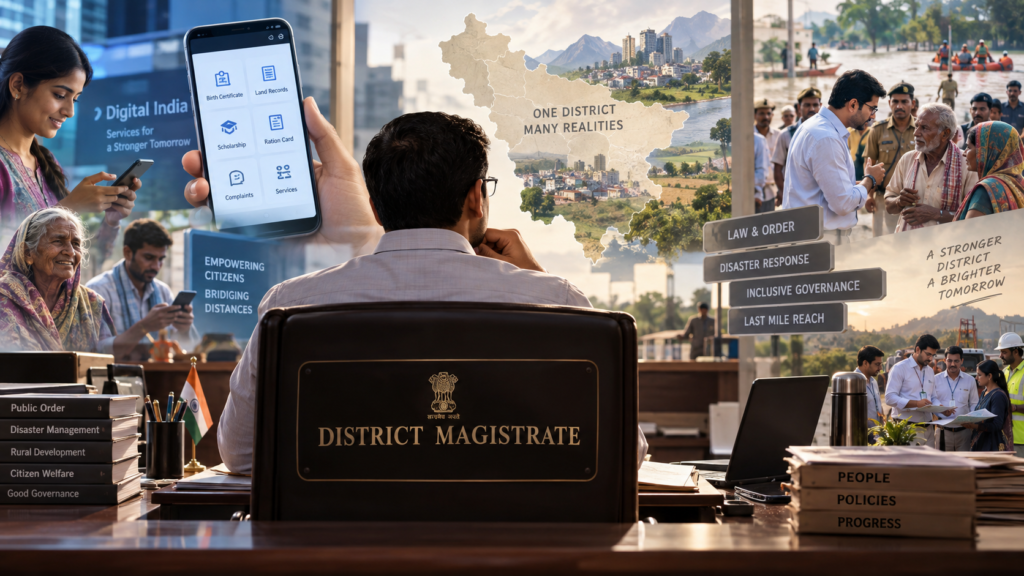
There was a time when the District Magistrate’s office was the place where everything stopped and started. You needed a certificate, you went there. Land records, ration cards, relief after a flood, permission for a procession—everything funnelled through that one office. The DM was not just an officer; he or she was the face of the state in the district. People knew the name, recognised the car, and measured the government’s presence by how approachable or distant that person seemed. That world has changed. Today a young person in a remote block can download a birth certificate, apply for a scholarship, check land details, and register a complaint without stepping into the collectorate. Portals, apps, and digital signatures have quietly taken over many of the routine tasks that once defined the magistrate’s day. So the question is no longer whether technology can deliver services. It can, and it does. The real question is what the District Magistrate is still for. The honest answer is that the job has not become smaller. It has become different, and in some ways harder. First, the DM remains the only officer who can still hold the entire district in one view. Algorithms and dashboards show numbers, but they do not show the texture of a place—the quiet tension in a mixed neighbourhood after a rumour, the way a delayed irrigation canal is turning into resentment, the sudden spike in migration from three particular villages. Data can flag anomalies; only a human presence can understand why they are happening. When services move online, the risk is that the state becomes efficient at the surface and blind underneath. The modern DM’s first responsibility is to stay connected to that under-layer. Second, digital systems create new kinds of exclusion. Not everyone has a smartphone that works, or a network that does not drop, or the confidence to navigate an online form. The elderly woman who still prefers the old way, the daily-wage worker who cannot afford data packs, the person whose Aadhaar has a spelling mismatch that no app can fix—these people do not disappear just because the portal is live. Someone has to notice them and make sure the system bends a little. That someone is still the District Magistrate. Ensuring that technology does not become another wall is now as important as building the technology itself. Third, the hardest work has always been the work that cannot be automated. Maintaining public order during a sensitive festival, deciding how to allocate scarce resources after a natural disaster, coordinating between departments that would rather not talk to each other, intervening when local politics turns ugly—these remain human judgements. No portal can call a midnight meeting of the police and the municipal body, or walk into a tense village and listen long enough for tempers to cool. The DM’s authority in these moments comes not from digital access but from the old-fashioned weight of being the state’s representative who is expected to be fair, firm, and present. There is also a quieter responsibility that technology has actually made more urgent. When everything is online, transparency becomes both easier and more fragile. Citizens can now track files and demand answers in real time. That is a gain. But it also means that any opacity or delay is immediately visible and can erode trust faster than before. The DM has to set a culture of responsiveness that goes beyond the software. If the portal says “pending” for three weeks, someone has to explain why, not hide behind the system. At the same time, we should not romanticise the past. The old system had its own delays, its own favouritism, its own exhaustion. Many officers spent more time signing papers than thinking about the district. Digital tools have freed them from some of that drudgery. The better DMs today use that freedom to travel more, listen more, and intervene earlier. The weaker ones simply retreat into the comfort of dashboards and circulars. The difference is not in the technology; it is in the temperament of the person holding the post. What should the modern District Magistrate actually be responsible for, then? For seeing the district as a living place rather than a set of metrics. For making sure that the digital state still reaches those who cannot easily reach it. For taking the decisions that no algorithm can take and standing by them. For creating space where departments talk to one another instead of working in parallel. And for protecting the idea that government, even when it is online, still has a human face that can be held accountable. None of this is glamorous. It will not produce dramatic statistics for annual reports. Yet it is the work that decides whether citizens experience the state as distant and mechanical or as something that still belongs to them. @Rohit Manral
The File Is Yours, So Why the Months of Waiting?
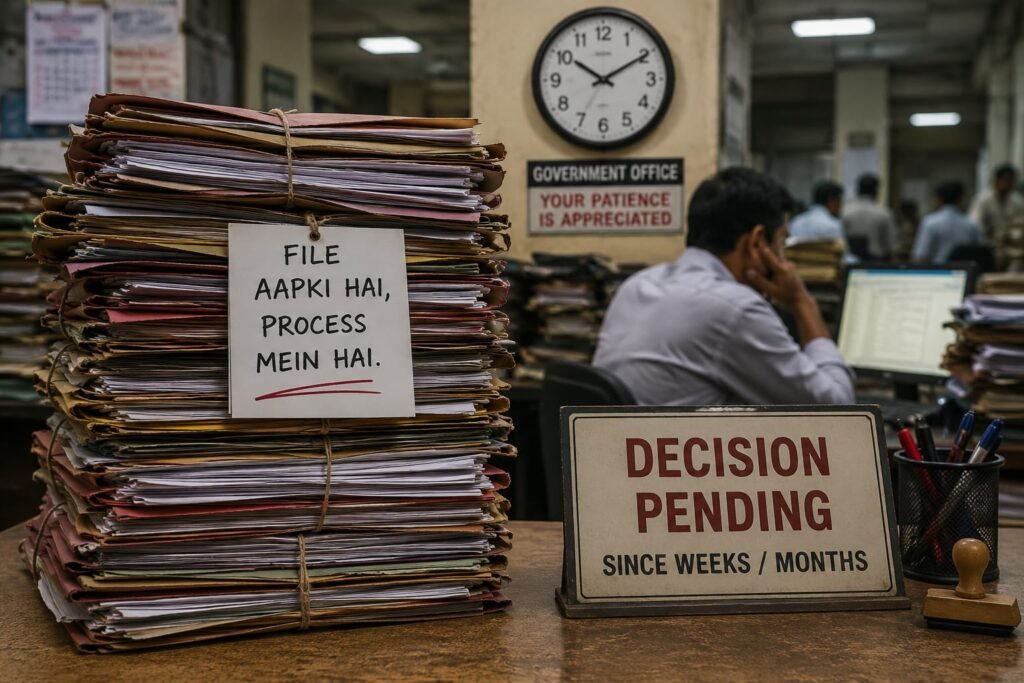
So many times it almost feels like a national anthem now. Someone walks into an office, the clerk or the officer looks at the thick file, nods, and says, “Haan, file aapki hai.” The file is yours. Everything is complete. All papers are inside. Signatures are there. Still the decision sits for weeks, sometimes months. You keep going back, drinking the same watery tea in the same dusty corridor, and the answer never changes. “Process mein hai.” Let’s talk straight, the way people actually talk when the peon isn’t listening. You submit a simple mutation of land. The papers are perfect. The survey is done. The file reaches the tehsildar’s table. He opens it, looks at it for thirty seconds, and closes it again. Why? Because the previous officer who handled similar files got transferred last month, and the new one is still “studying the system.” Or the clerk who knows which register to open is on leave for his sister’s wedding in another district. Or the stamp paper is of the old denomination and someone has to write a note about it. One small note becomes three notes, three notes become a file movement, and suddenly your land mutation is celebrating its third month inside a steel almirah. Same story with a simple building plan approval. The architect’s drawings are correct. The fire NOC is there. The structural certificate is there. Yet the file moves from junior engineer to assistant engineer to executive engineer to the municipal commissioner like a slow train that stops at every station even when no one is getting down. At every station someone finds a new “observation.” Height of the boundary wall is two inches more than allowed. Parking space calculation needs one more decimal. The signature on page 17 looks slightly different from page 3. You correct it. The file comes back with a new observation. By the time the final stamp arrives, the construction cost has gone up and the monsoon has already tested the temporary tin shed. I know a man who applied for a small government subsidy for a solar pump. The scheme was announced with big posters and bigger speeches. He filled every form, attached every bill, got the local agriculture officer’s recommendation. The file reached the district office. Then it went to the state office. Then it came back because one photocopy was not attested. He attested it. It went up again. Then someone discovered the bank account number was written in words instead of digits in one place. Corrected. Sent again. Meanwhile the financial year changed, the budget head changed, and the file was told to wait for the new financial year. When the money finally came, the pump he wanted had become more expensive and the electricity connection he needed had its own separate file that was still “under process.” Court matters are even better. A simple partition suit. Both sides agree on most things. The judge is ready. But one of the lawyers is busy in another court, the clerk has not put the file in the list because the previous day’s cases ran late, the process server could not find the correct address even though the house has been standing there for forty years, and suddenly three dates are gone. The file is still “yours.” The decision is still waiting. What makes it worse is the language everyone uses. No one says “I have not looked at it.” They say “file aapki hai, process mein hai.” It is a polite way of saying the system is larger than any single person, so no single person can be blamed. The officer who is supposed to sign is on election duty. The one who was trained on the new software has been transferred. The server is down. The printer has no toner. The higher authority has called for a meeting on something completely different. Every reason is true in its own small way, and together they become months. People outside sometimes think it is pure laziness. It is not always. Many officers work long hours. Many clerks know every rule better than the rule book. But the system is designed like an old road with too many speed breakers, too many check posts, and no one responsible for the total time. Each person only looks at his own small stretch. As long as his stretch is clean, the overall delay is someone else’s problem. You can see the same pattern in passport police verification that takes weeks even when the address has not changed for twenty years, in caste certificate renewals that ask for the same documents every time, in old-age pension files that move only when someone higher up asks for a progress report. The file is always “yours.” The decision is always “coming.” There is a strange honesty in that Hindi sentence. The officer is not lying when he says the file is yours. It is sitting on his table or in his cupboard. The power to decide is also with him or with the person one table away. Yet the months still pass. That gap between possession of the file and delivery of the decision is where the real Indian story lives — a mixture of caution, hierarchy, missing links, and the quiet belief that if you wait long enough, the problem might solve itself or the person asking might get tired. Next time someone tells you “file aapki hai,” smile and ask the only useful question left: “Toh decision kab tak aayega, and is there a date written anywhere?” Most of the time there isn’t. That is the purest truth of the whole system. @Rohit Manral
Why India Needs a Fresh Approach to Bureaucratic Accountability
There’s a phrase almost every Indian who has ever dealt with a government office has heard: “It’s still under process.” You hear it when a pension check is late, when a property transfer is stalled, when an income certificate never shows up, or when a complaint about some public service has been gathering dust for weeks. You file your paperwork, get a receipt, and then the waiting starts. One trip, you’re told the file is with a clerk. Next time, it’s moved to a section officer’s desk. A while later, it’s “pending approval.” Ask when it’ll actually be resolved, and nobody seems to know. Come back tomorrow. So you do. It might look like a minor annoyance on its own. But multiply it by millions of citizens, and it reveals something much bigger about how the Indian state thinks about accountability. When something gets held up in government, who’s actually on the hook for the delay? India’s administrative system has always leaned heavily on hierarchy, procedure, and rule-following. Files pass through set channels. Every decision needs a note, then a sign-off. Rules spell out who can act and when. There’s a real reason for that. No government can run purely on individual judgment calls. Rules bring consistency, guard public money, and prevent arbitrary decision-making. In a country as vast and complicated as India, procedural discipline matters. The trouble starts when following the procedure becomes the whole point, instead of a means to an end. A certificate that takes three months might have gone through every required approval, perfectly in line with protocol. A complaint might get logged, forwarded, and reviewed — and the actual problem might still be sitting there, unsolved. From the department’s point of view, the file moved. From the citizen’s point of view, nothing changed. That gap deserves a lot more attention than it gets. Still, the answer isn’t to paint bureaucrats as lazy or careless — that story is too easy, and usually wrong. Government officers work inside a system where every choice can be second-guessed from multiple directions. Rules are often tangled, staffing is thin, responsibilities overlap, and a decision made in good faith can be picked apart years later. In that kind of environment, it makes sense to play it safe. If deciding something carries more personal risk than putting it off does, delay becomes the logical move. Passing a file upward feels safer than deciding on it. Asking for “one more clarification” feels safer than using judgment. Waiting on a superior’s sign-off feels safer than being the one who owns the call. Over time, that builds a culture where playing it procedurally safe gets rewarded more often than taking initiative. That’s the piece of India’s accountability model that needs to change. The goal isn’t more oversight — it’s smarter oversight. First, responsibility needs to be clearer. A citizen shouldn’t have to decode an internal chain of command just to find out who’s handling their case. If something is pending, people deserve to know its current status, who’s responsible next, and roughly when to expect resolution. A published timeline shouldn’t be treated as optional — and when delays are unavoidable, the reason should be stated plainly. That single shift would make administrative delay something you can actually trace back to a source. Second — and just as important — performance shouldn’t be judged solely on whether the rulebook was followed. It also has to account for whether the outcome was actually achieved. That doesn’t mean scrapping procedural safeguards. It means treating procedure as the tool, not the goal itself. If a pension gets approved correctly on paper but reaches an elderly person months late, that’s not really a success story. If a grievance gets marked “resolved” in the system while the underlying issue is still unfixed, a closed file isn’t the same thing as a solved problem. For the person on the other end, this isn’t an abstract distinction. It touches their income, their access to basic services, their property, their job, and sometimes just their dignity. But shifting toward outcome-based accountability needs a safety net too: officers have to be free to make honest calls without living under constant threat of being punished after the fact. A system that comes down hard on every mistake doesn’t necessarily produce better governance — it might do the opposite. Officers stop wanting to decide anything. Files keep getting bumped upward. Choices get postponed. Responsibility gets spread so thin nobody really holds it. The end result: a bureaucracy that looks accountable on paper but is functionally stuck. So there needs to be a real distinction between deliberate wrongdoing, repeated failure to act, and an honest decision that simply didn’t pan out the way anyone hoped. Accountability should build a sense of ownership — not fear. There’s also a strong case for putting the citizen’s actual experience closer to the center of how government performance gets judged. Departments already track plenty of data — applications received, disposal rates, targets hit. But numbers can hide more than they reveal. A department might report that it “disposed of” thousands of applications. That’s a data point. It doesn’t tell you whether those cases were handled fairly, resolved in a reasonable time, or whether people had to keep showing up in person to get anything done. But shifting toward outcome-based accountability needs a safety net too: officers have to be free to make honest calls without living under constant threat of being punished after the fact. A system that comes down hard on every mistake doesn’t necessarily produce better governance — it might do the opposite. Officers stop wanting to decide anything. Files keep getting bumped upward. Choices get postponed. Responsibility gets spread so thin nobody really holds it. The end result: a bureaucracy that looks accountable on paper but is functionally stuck. So there needs to be a real distinction between deliberate wrongdoing, repeated failure to act, and an honest decision that simply didn’t pan out the way anyone hoped.