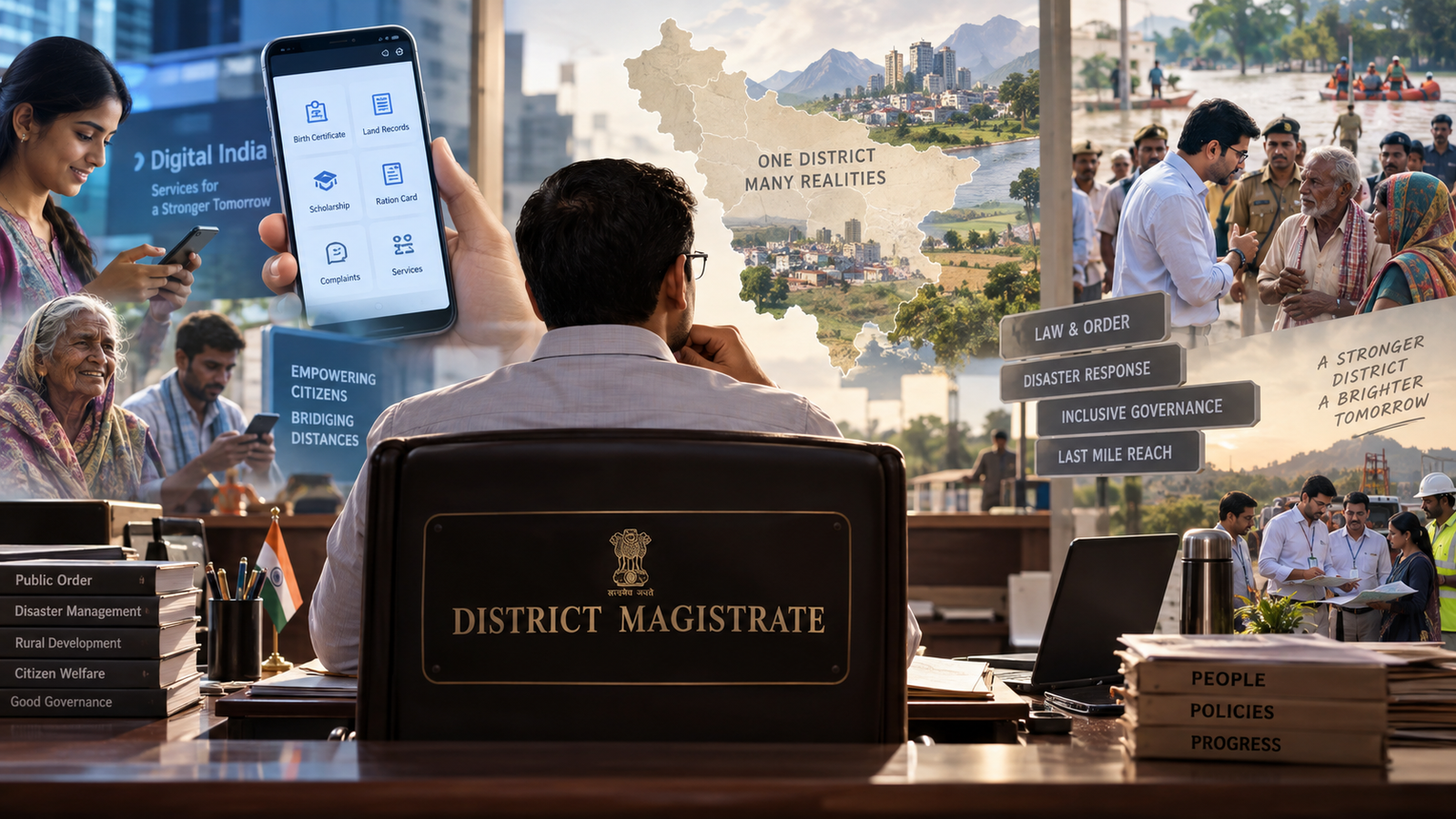
There was a time when the District Magistrate’s office was the place where everything stopped and started. You needed a certificate, you went there. Land records, ration cards, relief after a flood, permission for a procession—everything funnelled through that one office. The DM was not just an officer; he or she was the face of the state in the district. People knew the name, recognised the car, and measured the government’s presence by how approachable or distant that person seemed.
That world has changed. Today a young person in a remote block can download a birth certificate, apply for a scholarship, check land details, and register a complaint without stepping into the collectorate. Portals, apps, and digital signatures have quietly taken over many of the routine tasks that once defined the magistrate’s day. So the question is no longer whether technology can deliver services. It can, and it does. The real question is what the District Magistrate is still for.
The honest answer is that the job has not become smaller. It has become different, and in some ways harder.
First, the DM remains the only officer who can still hold the entire district in one view. Algorithms and dashboards show numbers, but they do not show the texture of a place—the quiet tension in a mixed neighbourhood after a rumour, the way a delayed irrigation canal is turning into resentment, the sudden spike in migration from three particular villages. Data can flag anomalies; only a human presence can understand why they are happening. When services move online, the risk is that the state becomes efficient at the surface and blind underneath. The modern DM’s first responsibility is to stay connected to that under-layer.
Second, digital systems create new kinds of exclusion. Not everyone has a smartphone that works, or a network that does not drop, or the confidence to navigate an online form. The elderly woman who still prefers the old way, the daily-wage worker who cannot afford data packs, the person whose Aadhaar has a spelling mismatch that no app can fix—these people do not disappear just because the portal is live. Someone has to notice them and make sure the system bends a little. That someone is still the District Magistrate. Ensuring that technology does not become another wall is now as important as building the technology itself.
Third, the hardest work has always been the work that cannot be automated. Maintaining public order during a sensitive festival, deciding how to allocate scarce resources after a natural disaster, coordinating between departments that would rather not talk to each other, intervening when local politics turns ugly—these remain human judgements. No portal can call a midnight meeting of the police and the municipal body, or walk into a tense village and listen long enough for tempers to cool. The DM’s authority in these moments comes not from digital access but from the old-fashioned weight of being the state’s representative who is expected to be fair, firm, and present.
There is also a quieter responsibility that technology has actually made more urgent. When everything is online, transparency becomes both easier and more fragile. Citizens can now track files and demand answers in real time. That is a gain. But it also means that any opacity or delay is immediately visible and can erode trust faster than before. The DM has to set a culture of responsiveness that goes beyond the software. If the portal says “pending” for three weeks, someone has to explain why, not hide behind the system.
At the same time, we should not romanticise the past. The old system had its own delays, its own favouritism, its own exhaustion. Many officers spent more time signing papers than thinking about the district. Digital tools have freed them from some of that drudgery. The better DMs today use that freedom to travel more, listen more, and intervene earlier. The weaker ones simply retreat into the comfort of dashboards and circulars. The difference is not in the technology; it is in the temperament of the person holding the post.
What should the modern District Magistrate actually be responsible for, then? For seeing the district as a living place rather than a set of metrics. For making sure that the digital state still reaches those who cannot easily reach it. For taking the decisions that no algorithm can take and standing by them. For creating space where departments talk to one another instead of working in parallel. And for protecting the idea that government, even when it is online, still has a human face that can be held accountable.
None of this is glamorous. It will not produce dramatic statistics for annual reports. Yet it is the work that decides whether citizens experience the state as distant and mechanical or as something that still belongs to them.
@Rohit Manral