The District Magistrate in the Age of Digital Governance— When citizens can access services online, what should the modern DM actually be responsible for?
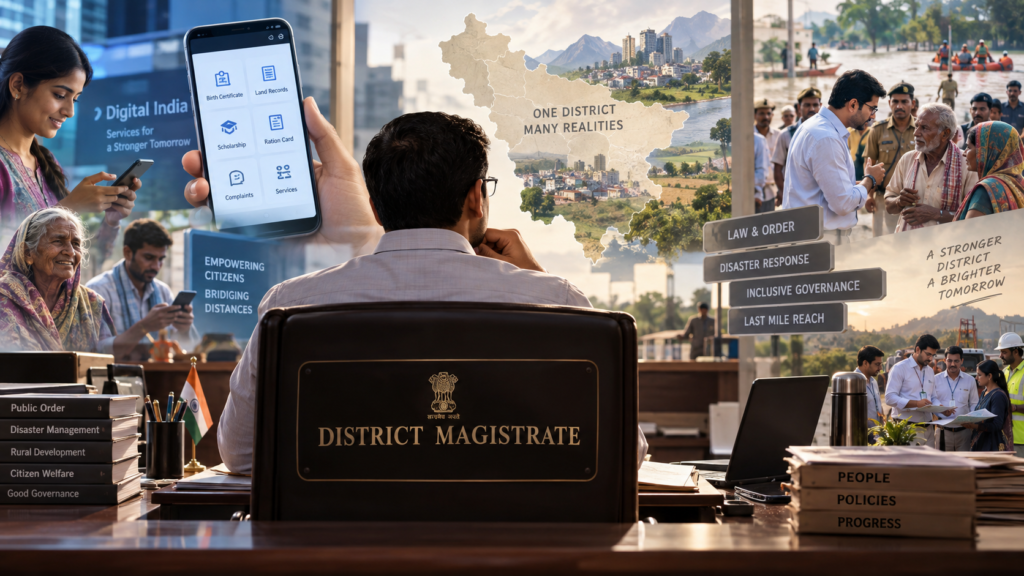
There was a time when the District Magistrate’s office was the place where everything stopped and started. You needed a certificate, you went there. Land records, ration cards, relief after a flood, permission for a procession—everything funnelled through that one office. The DM was not just an officer; he or she was the face of the state in the district. People knew the name, recognised the car, and measured the government’s presence by how approachable or distant that person seemed. That world has changed. Today a young person in a remote block can download a birth certificate, apply for a scholarship, check land details, and register a complaint without stepping into the collectorate. Portals, apps, and digital signatures have quietly taken over many of the routine tasks that once defined the magistrate’s day. So the question is no longer whether technology can deliver services. It can, and it does. The real question is what the District Magistrate is still for. The honest answer is that the job has not become smaller. It has become different, and in some ways harder. First, the DM remains the only officer who can still hold the entire district in one view. Algorithms and dashboards show numbers, but they do not show the texture of a place—the quiet tension in a mixed neighbourhood after a rumour, the way a delayed irrigation canal is turning into resentment, the sudden spike in migration from three particular villages. Data can flag anomalies; only a human presence can understand why they are happening. When services move online, the risk is that the state becomes efficient at the surface and blind underneath. The modern DM’s first responsibility is to stay connected to that under-layer. Second, digital systems create new kinds of exclusion. Not everyone has a smartphone that works, or a network that does not drop, or the confidence to navigate an online form. The elderly woman who still prefers the old way, the daily-wage worker who cannot afford data packs, the person whose Aadhaar has a spelling mismatch that no app can fix—these people do not disappear just because the portal is live. Someone has to notice them and make sure the system bends a little. That someone is still the District Magistrate. Ensuring that technology does not become another wall is now as important as building the technology itself. Third, the hardest work has always been the work that cannot be automated. Maintaining public order during a sensitive festival, deciding how to allocate scarce resources after a natural disaster, coordinating between departments that would rather not talk to each other, intervening when local politics turns ugly—these remain human judgements. No portal can call a midnight meeting of the police and the municipal body, or walk into a tense village and listen long enough for tempers to cool. The DM’s authority in these moments comes not from digital access but from the old-fashioned weight of being the state’s representative who is expected to be fair, firm, and present. There is also a quieter responsibility that technology has actually made more urgent. When everything is online, transparency becomes both easier and more fragile. Citizens can now track files and demand answers in real time. That is a gain. But it also means that any opacity or delay is immediately visible and can erode trust faster than before. The DM has to set a culture of responsiveness that goes beyond the software. If the portal says “pending” for three weeks, someone has to explain why, not hide behind the system. At the same time, we should not romanticise the past. The old system had its own delays, its own favouritism, its own exhaustion. Many officers spent more time signing papers than thinking about the district. Digital tools have freed them from some of that drudgery. The better DMs today use that freedom to travel more, listen more, and intervene earlier. The weaker ones simply retreat into the comfort of dashboards and circulars. The difference is not in the technology; it is in the temperament of the person holding the post. What should the modern District Magistrate actually be responsible for, then? For seeing the district as a living place rather than a set of metrics. For making sure that the digital state still reaches those who cannot easily reach it. For taking the decisions that no algorithm can take and standing by them. For creating space where departments talk to one another instead of working in parallel. And for protecting the idea that government, even when it is online, still has a human face that can be held accountable. None of this is glamorous. It will not produce dramatic statistics for annual reports. Yet it is the work that decides whether citizens experience the state as distant and mechanical or as something that still belongs to them. @Rohit Manral
What Can Your District Magistrate Actually Do? Explaining the Powers of the DM to You.
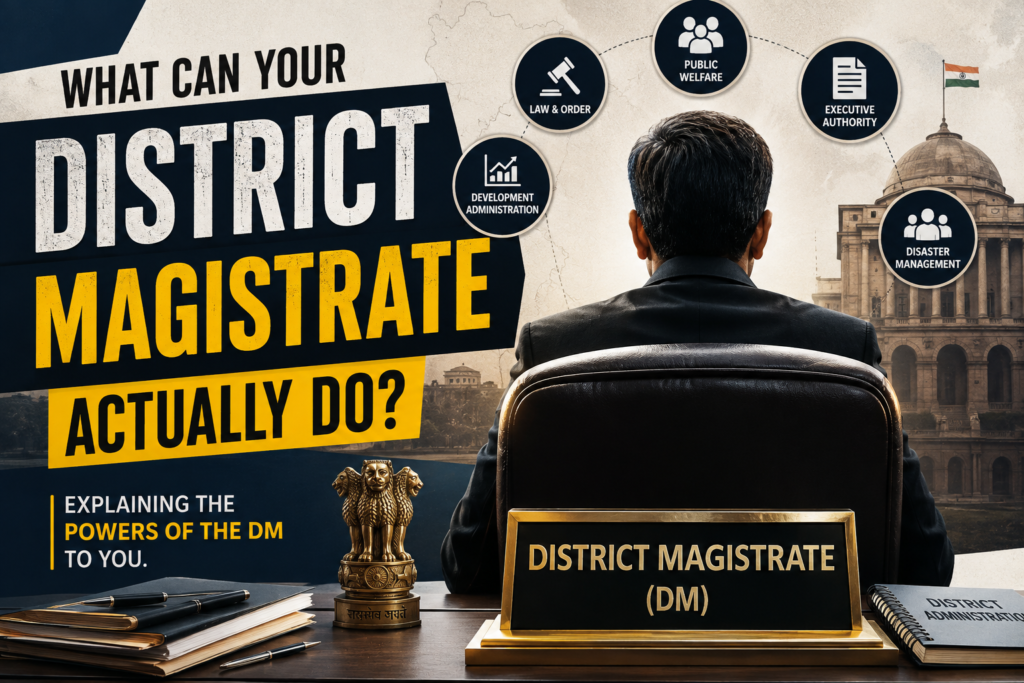
Public Voice | The Civic Code While talking of the District Magistrate, often one wonders about the actual powers he possesses. For, the DM (as he is popularly called) is one of the most empowered administrative heads at the district level and his powers can have a direct bearing on our daily lives. The DM looks after all matters in the district like, flood control, elections, police control, coordination between different government departments, and more. But, how far can a DM go? And what are actually the powers of a District Magistrate? Here is a district magistrate job description for you: Who Is the District Magistrate? The District Magistrate is the chief administrative authority for a district. In some states, the office of the Collector and District Magistrate are held together, while in some others, the powers vary as per state-specific rules. The District Magistrate acts as a government’s central figure for all matters pertaining to a certain district. He is responsible for coordination between various departments, and execution of government policies and orders in that district. The work of a DM affects all kinds of work that affects the citizen of the district and is directly related to day-to-day governance. For instance, some of the key functions of the District Magistrate are: 1. Maintains Law and Order in the District Even though, the responsibility of the police force falls directly under the Superintendent of Police (SP), the District Magistrate is the administrative head of the police force. The SP is primarily responsible for maintaining law and order in the district, but during a public order situation, the administrative powers of the DM are required to restore normalcy. The executive magistrate of the district has the power to impose police control in a given area, if he finds sufficient ground. However, during such situations, while the district police force is under the administrative control of the DM, he is not the head of the police force of that district. 2. Takes Care of Disasters in the District Floods, fires, and other such disasters can occur at any time and can cause total chaos in the state if not handled properly. It is the responsibility of the District Magistrate to take charge of such situations and make sure that proper resources are allocated towards disaster management and control. In addition to that, he is also responsible for coordinating the work of different bodies and authorities responsible to restore normalcy in the affected regions. 3. Handles Land Revenue Matters The reason why the term ‘Collector’ was used for the District Magistrate was because he was responsible for maintaining land revenue records in his district. Even today the district administration handles most land and revenue-related matters in consultation with the state government. But, a DM can neither change the land records of any person, nor can he settle property disputes on his own. 4. Looks After Conduct of Elections When it comes to conducting elections, we have the Election Commission handling all responsibilities. But, the District Administration also has a huge role to play in the process. It is the district administration that executes all directions given by the Election Commission. As it so happens, the District Magistrate acts as the District Election Officer for any elections in the district. Therefore, it might be possible that the DM is entrusted with any statutory power as a District Election Officer. However, this does NOT mean that he can act independently while conducting elections. 5. Implementation of Government Schemes Any schemes that are announced from New Delhi or the state capital require proper execution. But, what most of us forget is that it is the district administration that is responsible for implementation and execution. So, for any welfare scheme whether it is related to roads, development, education, health, or even sanitation, the District Magistrate will look after its successful implementation. But, this does NOT mean that he approves each and every application of benefits that a person might apply for. In most cases, government officials and district authorities will make sure that the concerned government department takes proper action. 6. Handles Public Grievances Whenever you have a problem that involves multiple government departments, you usually end up complaining to the district administration. The district administration is the primary authority for all matters relating to redressal of public grievances and complaints. Even the District Magistrate can look into your complaint, call the concerned authority for a report, and ask for an inspection to be made. This helps in resolving public grievances and complaint even faster. But, not everything goes as per the wishes of the DM. For, just like all other government officials, he too has his limitations. For instance, he cannot go against the orders of the state or central government. Also, his powers can be curtailed by judicial authorities depending on the situation on hand. So, can a DM do whatever he feels like? No! That is arguably the biggest misconception about the District Magistrate. The DM is a highly empowered administrative authority but the powers he possesses are only the ones bestowed upon him by laws and government regulations. Therefore, as much as he can affect change, a DM too is bound by the law and can be pulled up by authorities higher than him, especially judicial authorities. In short, while the District Magistrate is one of the highest administrative authorities in the district, he is by no means omnipotent. Why should you know the powers of your DM? Now, that you know what a District Magistrate is capable of, it might be a lot easier to approach him with your public grievances and complaints. For instance, if a road is damaged or a government scheme fails to deliver benefits to you, or the flood compensation is not delivered on time, or in case you have any other district-level issue, then knowing the powers of your DM will surely help you in approaching him for the redressal of your public grievance. In