Does being ‘faceless’ in the government system mean being ‘accountability-less’?
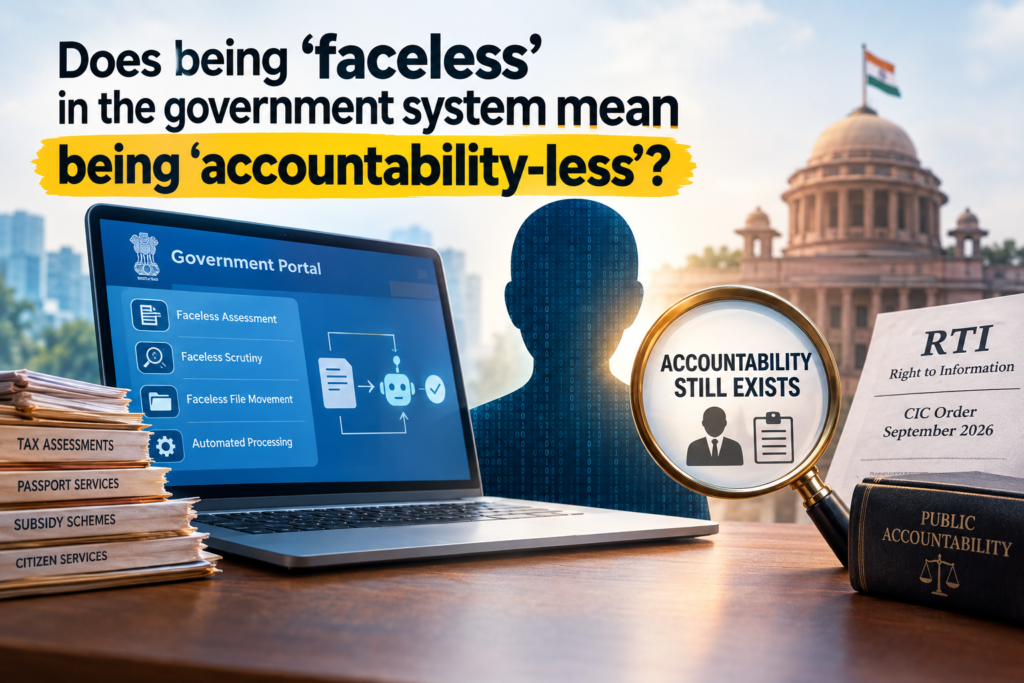
We keep hearing this word everywhere now — faceless. Faceless assessment, faceless scrutiny, faceless file movement, faceless everything. On paper it sounds clean. No face-to-face, no middlemen, less chance of someone asking for chai-paani. The machine does the work, the portal decides, the algorithm moves the file. Everyone claps. But here’s the real question that keeps coming back: when something goes wrong, who do you hold accountable? In September 2026, the Central Information Commission dealt with an RTI matter and said something that should have been obvious but somehow needed saying out loud. Automated or faceless administration cannot wipe out responsibility. Accountability does not disappear just because a human face is no longer visible on the file. That one line cuts through a lot of the current confusion. Think about how many people file RTIs these days only to get replies that basically say, “The system generated it,” or “It was processed under the faceless scheme,” or “No individual officer is involved.” It feels neat and technical. It also feels like a perfect escape route. The moment you remove the person, you also try to remove the responsibility that person carried. But systems don’t run themselves. Someone designs the rules the system follows. Someone decides which data goes in, which parameters matter, which exceptions are allowed, and when a case gets escalated. Someone sits in the control room even if the public never sees their name. Faceless does not mean ownerless. The CIC’s point was simple and sharp. You can automate the process. You cannot automate away the duty to answer for the outcome. If an order is wrong, if a file is delayed beyond reason, if a citizen is denied something they were entitled to, the public still has the right to know who decided what and on what basis. The RTI Act was never meant to stop at the edge of a software interface. We have seen this tension play out in tax assessments for years. Faceless assessments were sold as the end of harassment. In many cases they did reduce unnecessary meetings. Yet when a high-pitched demand comes or a genuine explanation is ignored, the assessee is left talking to a faceless unit. The same pattern is slowly spreading to other departments. Passport work, certain subsidy schemes, some service delivery portals — the human is being removed from the frame, and with it the easy trail of responsibility. That is dangerous. Accountability is not a luxury. It is the only thing that keeps power from becoming casual. When an officer knows that one day someone can ask, “Why did you take this decision?” the quality of decisions improves. When the same officer can hide behind “the system did it,” the quality starts slipping. Mistakes stop getting fixed. Patterns of error stop getting noticed. Citizens stop believing the process is fair. Some people argue that technology is neutral. It isn’t. Technology reflects the priorities of the people who build and manage it. If those people are not answerable, the technology becomes a shield instead of a tool. The CIC order simply refused to accept that shield as permanent. There is another layer to this. Faceless systems generate huge amounts of data and logs. In theory, those logs should make accountability stronger, not weaker. You should be able to pull up exactly when a decision was taken, which rule was applied, which officer last touched the case, and what the system recorded as the reason. But that only happens if the department is willing to treat those logs as public records under the RTI Act and not as internal technical details that citizens have no business seeing. Many still treat them as the latter. The September decision pushes in the opposite direction. It reminds public authorities that the shift to automated administration does not rewrite the basic compact between citizen and state. You can change the method of work. You cannot change the fact that the work is still being done in the name of the people and with public money. Therefore the people still get to ask questions. This is not an argument against technology. Nobody serious is saying we should go back to paper files and long queues for everything. Speed and reduced physical interface have real value. The argument is narrower and more important: do not use “faceless” as a synonym for “no one is responsible.” In the end it comes down to a simple test. If a citizen is harmed by an automated decision, is there a clear path to find out who owns that decision and how it can be corrected? If the answer is no, then the system has failed the purpose of public administration. If the answer is yes, then faceless can work. The CIC has now put it on record that the second answer is the only acceptable one. Automated processes are allowed. Accountability-less processes are not. That is not a technical observation. That is a democratic one. And it needed saying. Publisher By – Rohit Manral Written By – Anjali Pandey
Scheme Launched, But How Many Benefited?
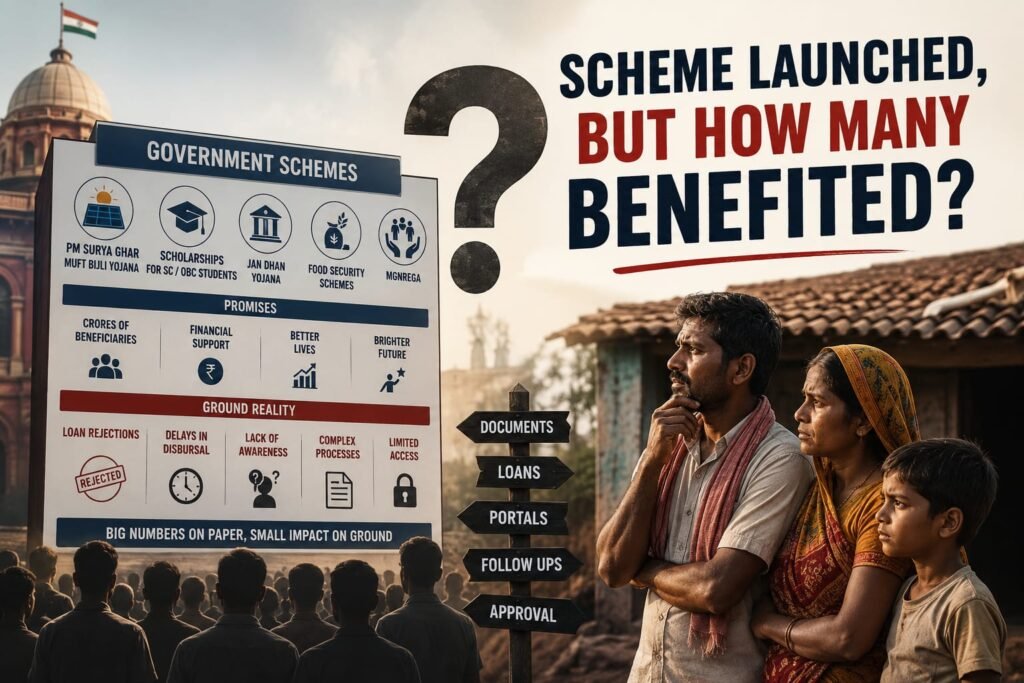
You know that feeling when the government announces a big new scheme with lots of noise, shiny ads, and promises of changing lives? Everyone gets excited for a while. Social media fills up with posts. Leaders cut ribbons. Targets are set in crores. Then, a year or two later, you sit with a cup of tea and quietly wonder… how many people actually got the benefit? This is not a new story in India. It keeps repeating. Take the Pradhan Mantri Surya Ghar: Muft Bijli Yojana. Launched in early 2024 with a big promise — free electricity for one crore households through rooftop solar. The idea sounded beautiful. Put panels on your roof, generate your own power, get subsidy, and even earn by selling extra units back to the grid. Budget allocation kept rising. By 2026-27 it was hiked to ₹22,000 crore. Official figures look impressive on paper. By mid-2026 the scheme had crossed 49-51 lakh beneficiary households. Installations jumped fast. Subsidies worth thousands of crores went into bank accounts through DBT. Nearly 19 lakh homes even reported zero electricity bills for some months. On the surface, it looks like a success story. But dig a little and the picture becomes less rosy. Parliamentary panels flagged high loan rejection rates. Out of more than five lakh loan applications, only around half were sanctioned at one point. Banks hesitated because of unclear house ownership papers. Private banks showed little interest. The scheme needs a proper concrete roof, ownership documents, some upfront money, and the ability to navigate an online portal. That automatically leaves out many poorer families, tenants, and people living in kutcha or semi-pucca houses. Experts have openly said the benefits are skewed towards middle-class urban and semi-urban households who already have the means. The ones who needed free power the most are often still waiting or not even in the race. This is the pattern we see again and again. Look at scholarships meant for SC and OBC students. A parliamentary panel recently pointed out serious delays in disbursal. Targets were missed. For one year the number of SC students who got scholarships dropped sharply compared to the ambitious target. The department could not even give clear beneficiary numbers for another year. Yet the target for the next year was cut. How does that help students who are already struggling with fees and books? Or take older schemes. Jan Dhan accounts crossed 58-59 crore. That is a massive number. Money is transferred. But many accounts still remain zero-balance or barely used for real credit and insurance claims. Insurance schemes under Jan Suraksha have huge enrolment figures, yet the actual claim settlements, while large in absolute terms, still leave many families without timely support because of awareness gaps and paperwork. Even food security schemes face questions. Allocations still rely on old census data in many places. Population has grown. Some studies suggest a good portion of grain never reaches the intended people. In places like Rajasthan, CAG reports on MGNREGA showed many workers getting far fewer than 100 days of work, incomplete projects, and unpaid unemployment allowances. Why does this keep happening? First, the focus is often on the announcement and the numbers that can be shown in Parliament or on social media. Actual last-mile delivery is harder. Digital portals are good, but when internet is weak, documents are missing, or the local official is unhelpful, the poor get left behind. Second, many schemes require the beneficiary to already have some resources — a bank account that works, a smartphone, some money for the initial cost, or the ability to follow up. The truly vulnerable often do not. Third, states and the Centre keep passing the blame. Money sits in accounts. Targets get revised downward quietly. Monitoring reports come late or stay incomplete. I am not saying every scheme is a failure. Some have genuinely reached large numbers. LPG connections under Ujjwala, free food grains under PMGKAY, and the sheer scale of direct transfers have made a difference for millions. But the gap between the big launch and the real benefit on the ground remains stubborn. What needs to change is simple, though not easy. Better targeting. Independent audits that are published on time. Simpler processes so that a daily-wage worker does not need to run around for months. Real-time dashboards that ordinary people can check. And most importantly, the courage to admit when a scheme is not reaching the bottom and then fix it instead of just announcing the next one. Next time you see a grand scheme launch on TV, pause for a moment. Ask the quiet question that rarely makes it to the headlines: Scheme launched… but how many actually benefited? The answer usually tells us more about the state of governance than any press release ever will. @Rohit Manral
Why India Needs a Fresh Approach to Bureaucratic Accountability
There’s a phrase almost every Indian who has ever dealt with a government office has heard: “It’s still under process.” You hear it when a pension check is late, when a property transfer is stalled, when an income certificate never shows up, or when a complaint about some public service has been gathering dust for weeks. You file your paperwork, get a receipt, and then the waiting starts. One trip, you’re told the file is with a clerk. Next time, it’s moved to a section officer’s desk. A while later, it’s “pending approval.” Ask when it’ll actually be resolved, and nobody seems to know. Come back tomorrow. So you do. It might look like a minor annoyance on its own. But multiply it by millions of citizens, and it reveals something much bigger about how the Indian state thinks about accountability. When something gets held up in government, who’s actually on the hook for the delay? India’s administrative system has always leaned heavily on hierarchy, procedure, and rule-following. Files pass through set channels. Every decision needs a note, then a sign-off. Rules spell out who can act and when. There’s a real reason for that. No government can run purely on individual judgment calls. Rules bring consistency, guard public money, and prevent arbitrary decision-making. In a country as vast and complicated as India, procedural discipline matters. The trouble starts when following the procedure becomes the whole point, instead of a means to an end. A certificate that takes three months might have gone through every required approval, perfectly in line with protocol. A complaint might get logged, forwarded, and reviewed — and the actual problem might still be sitting there, unsolved. From the department’s point of view, the file moved. From the citizen’s point of view, nothing changed. That gap deserves a lot more attention than it gets. Still, the answer isn’t to paint bureaucrats as lazy or careless — that story is too easy, and usually wrong. Government officers work inside a system where every choice can be second-guessed from multiple directions. Rules are often tangled, staffing is thin, responsibilities overlap, and a decision made in good faith can be picked apart years later. In that kind of environment, it makes sense to play it safe. If deciding something carries more personal risk than putting it off does, delay becomes the logical move. Passing a file upward feels safer than deciding on it. Asking for “one more clarification” feels safer than using judgment. Waiting on a superior’s sign-off feels safer than being the one who owns the call. Over time, that builds a culture where playing it procedurally safe gets rewarded more often than taking initiative. That’s the piece of India’s accountability model that needs to change. The goal isn’t more oversight — it’s smarter oversight. First, responsibility needs to be clearer. A citizen shouldn’t have to decode an internal chain of command just to find out who’s handling their case. If something is pending, people deserve to know its current status, who’s responsible next, and roughly when to expect resolution. A published timeline shouldn’t be treated as optional — and when delays are unavoidable, the reason should be stated plainly. That single shift would make administrative delay something you can actually trace back to a source. Second — and just as important — performance shouldn’t be judged solely on whether the rulebook was followed. It also has to account for whether the outcome was actually achieved. That doesn’t mean scrapping procedural safeguards. It means treating procedure as the tool, not the goal itself. If a pension gets approved correctly on paper but reaches an elderly person months late, that’s not really a success story. If a grievance gets marked “resolved” in the system while the underlying issue is still unfixed, a closed file isn’t the same thing as a solved problem. For the person on the other end, this isn’t an abstract distinction. It touches their income, their access to basic services, their property, their job, and sometimes just their dignity. But shifting toward outcome-based accountability needs a safety net too: officers have to be free to make honest calls without living under constant threat of being punished after the fact. A system that comes down hard on every mistake doesn’t necessarily produce better governance — it might do the opposite. Officers stop wanting to decide anything. Files keep getting bumped upward. Choices get postponed. Responsibility gets spread so thin nobody really holds it. The end result: a bureaucracy that looks accountable on paper but is functionally stuck. So there needs to be a real distinction between deliberate wrongdoing, repeated failure to act, and an honest decision that simply didn’t pan out the way anyone hoped. Accountability should build a sense of ownership — not fear. There’s also a strong case for putting the citizen’s actual experience closer to the center of how government performance gets judged. Departments already track plenty of data — applications received, disposal rates, targets hit. But numbers can hide more than they reveal. A department might report that it “disposed of” thousands of applications. That’s a data point. It doesn’t tell you whether those cases were handled fairly, resolved in a reasonable time, or whether people had to keep showing up in person to get anything done. But shifting toward outcome-based accountability needs a safety net too: officers have to be free to make honest calls without living under constant threat of being punished after the fact. A system that comes down hard on every mistake doesn’t necessarily produce better governance — it might do the opposite. Officers stop wanting to decide anything. Files keep getting bumped upward. Choices get postponed. Responsibility gets spread so thin nobody really holds it. The end result: a bureaucracy that looks accountable on paper but is functionally stuck. So there needs to be a real distinction between deliberate wrongdoing, repeated failure to act, and an honest decision that simply didn’t pan out the way anyone hoped.