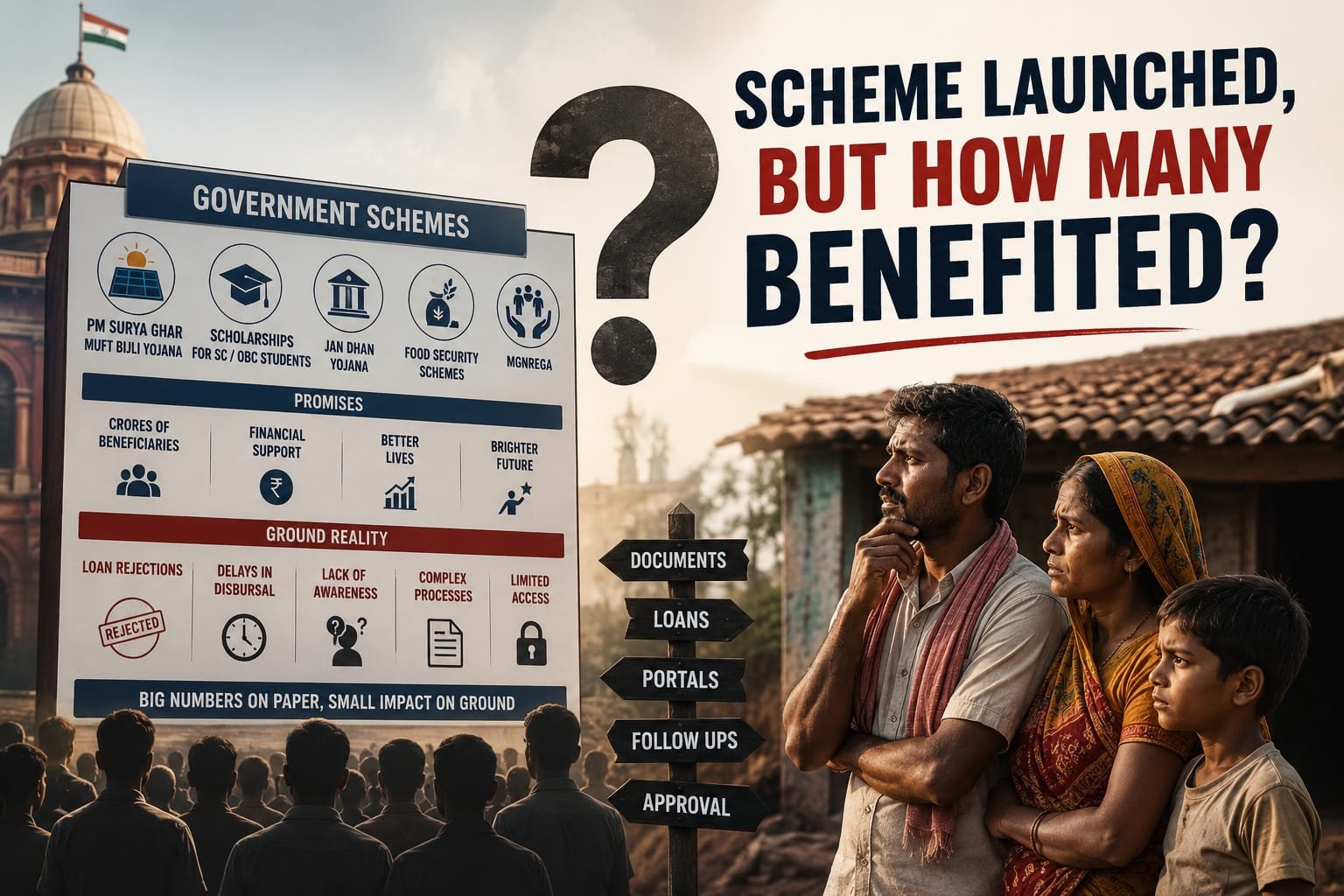
You know that feeling when the government announces a big new scheme with lots of noise, shiny ads, and promises of changing lives? Everyone gets excited for a while. Social media fills up with posts. Leaders cut ribbons. Targets are set in crores. Then, a year or two later, you sit with a cup of tea and quietly wonder… how many people actually got the benefit?
This is not a new story in India. It keeps repeating.
Take the Pradhan Mantri Surya Ghar: Muft Bijli Yojana. Launched in early 2024 with a big promise — free electricity for one crore households through rooftop solar. The idea sounded beautiful. Put panels on your roof, generate your own power, get subsidy, and even earn by selling extra units back to the grid. Budget allocation kept rising. By 2026-27 it was hiked to ₹22,000 crore. Official figures look impressive on paper. By mid-2026 the scheme had crossed 49-51 lakh beneficiary households. Installations jumped fast. Subsidies worth thousands of crores went into bank accounts through DBT. Nearly 19 lakh homes even reported zero electricity bills for some months. On the surface, it looks like a success story.
But dig a little and the picture becomes less rosy.
Parliamentary panels flagged high loan rejection rates. Out of more than five lakh loan applications, only around half were sanctioned at one point. Banks hesitated because of unclear house ownership papers. Private banks showed little interest. The scheme needs a proper concrete roof, ownership documents, some upfront money, and the ability to navigate an online portal. That automatically leaves out many poorer families, tenants, and people living in kutcha or semi-pucca houses. Experts have openly said the benefits are skewed towards middle-class urban and semi-urban households who already have the means. The ones who needed free power the most are often still waiting or not even in the race.
This is the pattern we see again and again.
Look at scholarships meant for SC and OBC students. A parliamentary panel recently pointed out serious delays in disbursal. Targets were missed. For one year the number of SC students who got scholarships dropped sharply compared to the ambitious target. The department could not even give clear beneficiary numbers for another year. Yet the target for the next year was cut. How does that help students who are already struggling with fees and books?
Or take older schemes. Jan Dhan accounts crossed 58-59 crore. That is a massive number. Money is transferred. But many accounts still remain zero-balance or barely used for real credit and insurance claims. Insurance schemes under Jan Suraksha have huge enrolment figures, yet the actual claim settlements, while large in absolute terms, still leave many families without timely support because of awareness gaps and paperwork.
Even food security schemes face questions. Allocations still rely on old census data in many places. Population has grown. Some studies suggest a good portion of grain never reaches the intended people. In places like Rajasthan, CAG reports on MGNREGA showed many workers getting far fewer than 100 days of work, incomplete projects, and unpaid unemployment allowances.
Why does this keep happening?
First, the focus is often on the announcement and the numbers that can be shown in Parliament or on social media. Actual last-mile delivery is harder. Digital portals are good, but when internet is weak, documents are missing, or the local official is unhelpful, the poor get left behind. Second, many schemes require the beneficiary to already have some resources — a bank account that works, a smartphone, some money for the initial cost, or the ability to follow up. The truly vulnerable often do not. Third, states and the Centre keep passing the blame. Money sits in accounts. Targets get revised downward quietly. Monitoring reports come late or stay incomplete.
I am not saying every scheme is a failure. Some have genuinely reached large numbers. LPG connections under Ujjwala, free food grains under PMGKAY, and the sheer scale of direct transfers have made a difference for millions. But the gap between the big launch and the real benefit on the ground remains stubborn.
What needs to change is simple, though not easy. Better targeting. Independent audits that are published on time. Simpler processes so that a daily-wage worker does not need to run around for months. Real-time dashboards that ordinary people can check. And most importantly, the courage to admit when a scheme is not reaching the bottom and then fix it instead of just announcing the next one.
Next time you see a grand scheme launch on TV, pause for a moment. Ask the quiet question that rarely makes it to the headlines: Scheme launched… but how many actually benefited? The answer usually tells us more about the state of governance than any press release ever will.
@Rohit Manral